


What is Time?
Open Time
This is Part Two of the three-part exploration of time, change, processing, and consciousness. In Part One, we began with change and followed it through succession, recurrence, rhythm, and rate, arriving at the possibility that time emerges from relationships between processes rather than existing independently of them. And now we turn to the processes themselves.
What is a clock actually doing?
Why can different clocks accumulate different amounts of time?
Can different structures operate according to different rhythms?
And if every processor exists within larger systems, how might those surrounding systems influence its processing?
A Note Before We Continue
We’re approaching half-time…
This is still part of a LOOOOONG narrative, and the repetition continues by design. Ideas from Part One will reappear again because we are now looking at them from another level:
Rhythm, rate, clocks, processors, and nested systems.
What initially looked like a simple sequence becomes more interesting when we compare different processes and examine how their rhythms relate to one another. The goal here is not to introduce an entirely new argument, but to stress-test and extend the one already underway.
If Part One asked where Time begins, Part Two asks what happens when multiple processes, each with their own rhythms, exist together.
Contents
Plurality Of Time — Why do clocks accumulate different amounts of time?
Two Pieces Of A Puzzle — What do clocks reveal about time?
The Processes — What is a clock actually measuring?
Matryoshka Clocks — Can different processes have different rhythms?
As Above, So Below — How does environment influence processing?
What Is Consciousness? — What happens when processing becomes integrated?


Plurality Of Time
What Relativity Tells Us About Clocks
So far, we have approached time from the direction of process. Armstrong’s faucets showed how recurring processes can be compared. PET’s four-phase cycle showed how recurring processes can generate rhythm. But there is an important question we can now ask:
Do different physical environments actually affect the rates of clocks?
This is where the work of Neil Ashby and Bijunath R. Patla becomes particularly relevant. In their paper, A Comparative Study of Time on Mars with Lunar and Terrestrial Clocks, they examine how identical atomic clocks would accumulate proper time (the time measured by a clock that travels along the same path or world line as an observer or object) when situated in different planetary environments.
The result is not that all clocks simply tick at one universal operational rate. Clocks on Earth, the Moon, and Mars accumulate different amounts of proper time because their physical trajectories and environments differ.
For Mars in particular, the authors calculate a significant difference between the proper time accumulated by a clock on Mars and one on Earth’s geoid, together with variations over the course of the Martian year.
The differences are extremely small on a human scale. But precision timekeeping makes them measurable. And that is precisely why the result matters here. We are no longer dealing with a philosophical thought experiment. We are dealing with physical systems whose measured rates differ.
What Relativity Says
Within general relativity, the explanation is well established within the Standard Cosmological Model. A clock follows a worldline (the unique path that an object or particle traces through four-dimensional spacetime) through spacetime (a mathematical model that combines the three dimensions of space, such as length, width, and height, with the single dimension of time into one four-dimensional framework).
The amount of proper time accumulated along that worldline depends upon the clock’s motion and the spacetime geometry through which it travels. Consequently, two identical clocks can accumulate different amounts of proper time when placed on different trajectories.
The clock itself has not become defective. There is no need to declare one clock “wrong”. They have simply followed different physical paths. Ashby and Patla’s calculations take this seriously by considering the relevant gravitational and orbital relationships rather than treating Earth, Mars and the Moon as completely isolated systems.
From the relativistic perspective, therefore, the important question is not, “Which clock has the correct time?” It is, “How much proper time does each clock accumulate along its particular trajectory?” And that, to me, is an intriguing result. It tells us that the rate at which clocks accumulate time is not operationally identical everywhere.
The PET Question Is Different
PET does not dispute the calculation. Nor does this paper demonstrate PET. That is important. Ashby and Patla are working within the framework of relativity and precision timekeeping. Their calculations are concerned with proper time, spacetime geometry, orbital motion, and the practical consequences for future interplanetary navigation and communication.
PET asks a different question. Instead of beginning with, “How does spacetime determine the rate of a clock?” PET asks, “What is the physical process occurring within the clock whose rate we call time?”
This is not a rejection of the measurement. It is a question about what the measurement represents. An atomic clock is a physical system. It receives and exchanges energy. Its internal states undergo highly regular transitions. Those transitions generate a repeatable rhythm. Electronics detect and count them.
The result becomes information that we interpret as a measurement of elapsed time. From the PET perspective, therefore, the clock is not a passive instrument sitting outside the phenomenon it measures. The clock is itself a process. Its temporal rate is expressed through the rate of its own physical state changes.
Beyond Four-Dimensional Spacetime
This is where PET deliberately steps outside the language and logic of the standard cosmological framework. It does not need to describe reality in terms of four-dimensional spacetime, nor does it accept that time must be treated as a fourth dimension added to the three dimensions of space.
Within PET, time is not a dimension that sits alongside length, width, and height and then somehow modifies the geometry of space. Time is the rate at which three-dimensional physical structures change, shift, interact, and process information-energy. Space does not travel through time. Rather, structures within space undergo state changes, and the rates of those changes are what temporal measurement quantifies.
This makes the PET question fundamentally different from the relativistic question. Rather than asking how an object accumulates proper time along a worldline through spacetime, PET asks what physical processes are occurring within the object, how those processes are changing, and how their rates compare with other processes.
In that sense, PET is demonstrably and conceptually much closer to the Electric Universe and Plasma Cosmology framework and to Michael Armstrong’s process-based interpretation of time than to the Standard Cosmological Model and the relativistic approach used by Neil Ashby and Bijunath R. Patla.
PET is not attempting to translate its model into relativistic language. It is proposing that we can begin with the physical processes themselves and derive the temporal relationships from them, without making time a dimension in the first place.
Different Environments, Different Rates
As I was saying, the clock is itself a process. Its temporal rate is expressed through the rate of its own physical state changes. This then becomes particularly interesting when we consider the planetary comparison.
Earth, the Moon, and Mars are not identical physical environments. They differ in their electromagnetic conditions, plasma environments, orbital relationships, rotational periods, and other physical parameters.
A processor embedded within such an environment is therefore not isolated from it. Its behaviour occurs within a larger system. The conventional relativistic interpretation identifies spacetime geometry and the clock’s trajectory as the relevant determinants of proper time.
PET asks whether there is also value in examining the physical processing itself.
What changes within the clock?
What determines the stability of its oscillation?
What interactions influence its state transitions?
How does its environment couple to those processes?
And more broadly:
Do all physical processors respond to environmental conditions by altering their characteristic rhythms?
These questions move beyond what Ashby and Patla set out to investigate. They are PET questions.
One Clock Is Not “Time”
This brings us back to the distinction established earlier. We often speak as though a clock measures time itself. But the comparison between Earth, Moon, and Mars clocks makes that language less straightforward. If two identical clocks accumulate different amounts of proper time under different physical conditions, then the clock is clearly not simply reading a universal external quantity in the same way everywhere.
It is undergoing a physical process along a particular trajectory. The measurement is a relationship between that process and the reference system used to describe it.
That does not make time unreal. It makes the measurement relational. And this is where Ashby and Patla provide an important bridge to PET. Their calculations do not tell us that time is emergent. They do not establish that time is the rate of information-energy processing. And they do not address consciousness.
What they do establish is much narrower, and therefore much more useful:
Precision clocks in different physical circumstances do not accumulate identical amounts of proper time, and that empirical fact allows us to ask a deeper question without pretending that the paper has already answered it.
From Proper Time to Physical Process
Relativity gives us a fairly reasonable mathematical description of how clocks accumulate proper time. But PET begins one step further down. If a physical process produces a clock’s reading, then perhaps we should investigate the process itself.
The clock contains an oscillator. The oscillator undergoes state changes. Those state changes recur. Their recurrence establishes a rhythm. The rhythm has a rate. That rate is compared with other processes. The comparison provides a temporal measure.
PET reframes the question, so that rather than asking where the clock finds time, it instead asks what the clock is physically doing. And that question can then be extended far beyond atomic clocks. If time is related to the rate of organised physical processing, then every organised processor may possess characteristic temporal rhythms.
A clock provides an unusually stable example. A biological organism provides a vastly more complicated one. And a planetary system provides another. Each operates through nested processes, each with characteristic rates and relationships to the processes around it. The clock on Mars does not therefore prove PET. But it gives PET an important empirical foothold:
Temporal rates are physically relational.
And once that is established, the next question becomes unavoidable:
What happens to a processor’s characteristic rate when its environment changes?
That takes us from worlds apart to the environments within which every processor exists.
The Difference Between Clocks
Why don’t identical clocks accumulate identical time?
In 2022, researchers at JILA, jointly operated by NIST and the University of Colorado Boulder, led by Jun Ye, measured a difference in the rate of two portions of an optical atomic clock separated vertically by approximately one millimetre. The experiment was sensitive enough to detect the gravitational redshift predicted by general relativity across a distance comparable to the width of a pencil tip.
The result is remarkable regardless of how one interprets its mechanism. A physical clock process occurring at one elevation does not accumulate exactly the same elapsed proper time as the corresponding process at another elevation. The difference is extraordinarily small, but modern optical clocks are precise enough to resolve it.
General relativity describes this difference in terms of gravitational time dilation. PET asks a very different question:
If what we call time is inseparable from physical processes, what does it mean for the rate of those processes to change with their environment?
That question does not overturn the measurement. It begins from it.
“Modern cosmology fuses the concepts of space and time into a thing, called a four-dimensional continuum. Albert Einstein predicted, and recently scientists have claimed to observe ripples in the so-called fabric of space-time.
But is it valid to define time in such a way as to reify it, and does a more valid definition of time exist?
Today, we explore one of the most basic questions in all of cosmology: What is time?”
- Michael Armstrong, The Thunderbolts Project (YouTube)
Two Pieces Of A Puzzle
Armstrong + Ashby & Patla
Two very different approaches to time have now brought us to a similar point. Michael Armstrong begins with a simple question about comparison. Ashby and Patla begin with precision measurements of atomic clocks operating in different physical circumstances. Neither is proposing PET. But together, their work provides two important pieces of the puzzle that PET attempts to connect.
Armstrong
Time Is Relational
Armstrong’s faucet thought experiment gives us the first piece. A single repeating process establishes succession. One drop follows another. But to quantify the interval between those events, we need another process against which the first can be compared.
Introduce a second repeating process and a relationship becomes possible. Introduce additional processes and increasingly sophisticated temporal scales can be constructed. The important insight is therefore:
We do not directly observe time. We observe processes changing and establish temporal relationships by comparing those processes.
Time becomes measurable through relationships between recurring processes. As a result, Armstrong gives us a useful conceptual starting point:
Time is relational.
Ashby & Patla
Clock Rates Are Local
Ashby and Patla provide a very different kind of evidence. Their calculations show that identical atomic clocks situated in different planetary environments accumulate different amounts of proper time. The clocks are not all accumulating an identical amount of elapsed time. Their rates depend upon their physical trajectories and the gravitational environment described by general relativity. And so this gives us the second piece:
Clock rates are physically local and dependent upon circumstances.
Again, this does not establish PET. Ashby and Patla explain their results through the relativistic framework of spacetime geometry and proper time. But their work demonstrates something important for the question we are asking.
The temporal rate associated with a physical clock cannot simply be treated as an identical operational quantity everywhere. The physical circumstances of the clock matter.
Putting the Two Together
Now place the two observations beside one another:
Armstrong — Processes become temporally meaningful through comparison.
Ashby & Patla — Physical clocks in different circumstances accumulate different amounts of proper time.
This leaves us with a deeper question. If temporal measurement is relational, and if the physical processes used to establish temporal measurements behave differently under different conditions, then:
What is the underlying physical process whose rate we are actually comparing?
This is where PET enters. It proposes that the answer is:
Organised information-energy processing.
A clock is not simply an object that happens to display time. It is a physical processor. It receives and exchanges energy. It undergoes state changes. It produces recurring patterns. Those patterns have characteristic rhythms. Their rates can be compared with the rhythms of other processes. The resulting relationship can be expressed as a measurement of time.
PET Takes the Question One Step Further… Again
This is another important distinction. PET is not taking the established observation that clocks can run at different rates and simply giving it a new name. Nor is it claiming that Armstrong or Ashby and Patla somehow demonstrated the PET framework. They did not.
Armstrong provides a useful conceptual insight into the relational character of temporal measurement. Ashby and Patla provide precise calculations showing how clock proper time differs between physical circumstances. PET simply asks what lies beneath both observations.
What is actually changing?
What is recurring?
What is generating the rhythm?
What determines its rate?
And what is being compared when we say that one clock has accumulated more or less time than another?
PET’s proposed answer begins with information and energy. When information and energy become organised, physical processors emerge. When processors process, their states change. When those changes recur, cycles and rhythms emerge. When those rhythms have rates, they can be compared. And when those rates are compared, temporal relationships become measurable.
The progression is therefore:
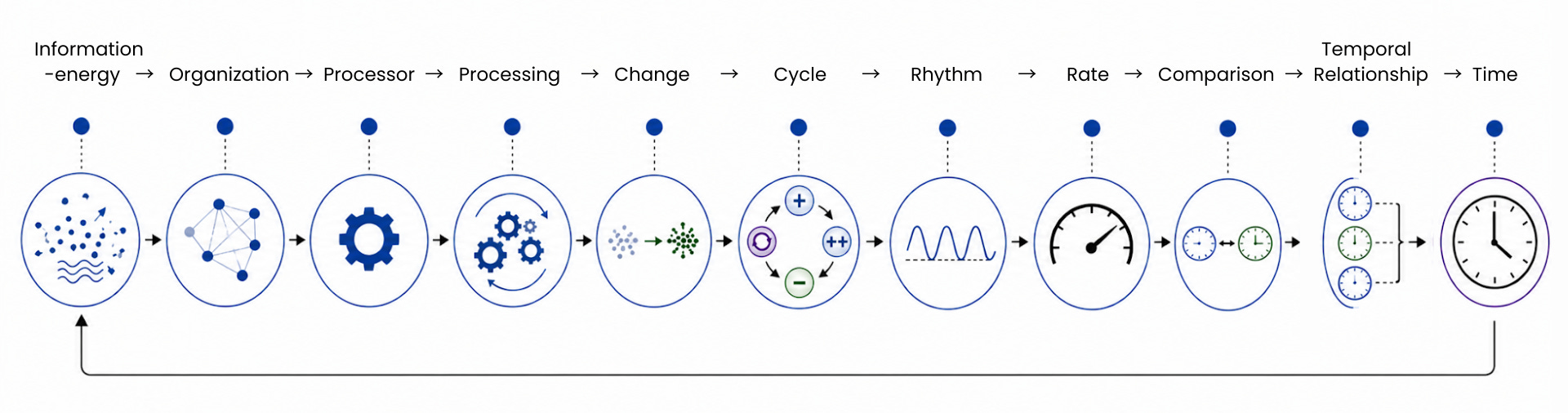
This is not merely a new vocabulary for relativity. It is a proposed underlying process model.
From Measurement to Mechanism
The distinction can be put very simply. Standard timekeeping asks, “How much time has elapsed? Relativity asks, “How much proper time does this physical trajectory accumulate?” Armstrong asks us to consider, “How do processes become temporally comparable?” And PET, as usual, asks a further question:
What physical processing produces the changing states and rhythms that make temporal comparison possible in the first place?
That final question is the one this article is pursuing. The clock remains important. Relativity remains somewhat useful. Precision measurement remains essential. But none of them requires us to imagine that a mysterious substance called time is flowing through the clock.
The clock undergoes a physical process. We compare that process with another. The relationship between their rates becomes a temporal measurement. And PET proposes that this principle extends far beyond clocks.
Every organised information-energy processor undergoes processes. Every processor has characteristic rhythms. Every rhythm has a rate. Every processor exists within other processes and contains processes of its own. Time therefore becomes not a thing that exists independently of physical reality, but a property that emerges from the relationships between changing processes.
That is the more profound interpretation PET brings to the puzzle. Armstrong gives us relationality. Ashby and Patla give us physical locality. And PET proposes the underlying process:
Organised information-energy processing.
The next question may, or may not, therefore be the most important one yet:
What happens when the environment changes the processor?
From Difference to Relationship
What does a difference in clock rate actually tell us?
The University of Colorado Boulder experiment gave us two pieces of information:
There is a physical process, and its rate can differ relative to another physical process. The clock comparison is therefore not measuring an abstract substance called time. It is comparing the rate of processing between two processors.


The Processor
Processing Information & Energy
We have now moved from change to cycles, from cycles to rhythms, and from rhythms to measurable rates.
But what, exactly, is producing those changes?
PET introduces a broader conceptual unit:
The processor.
A processor is any organised structure capable of receiving, transforming, storing, and transmitting information-energy. This definition deliberately extends beyond computers, brains, and other things we ordinarily call processors.
A clock processes physical energy, albeit through a constrained sequence of artificial states. A cell processes information-energy. An organism processes information-energy. A nervous system processes information-energy. A planetary system processes information-energy.
The important point is not that all of these are conscious in the naturally emergent and self-organizing sense. The important point is that they process. And if a processor undergoes recurring state changes, then it has a characteristic rhythm. And so that gives us another PET proposition:
Every processor has a characteristic rhythm; therefore a characteristic temporal rate.
How Is a Clock an Information-Energy Processor?
A clock is perhaps the simplest physical example of this idea. It cannot operate without energy.
A mechanical clock uses energy stored in a spring or weight. A quartz clock uses electrical energy to drive an oscillator. An atomic clock uses electromagnetic interactions to interrogate and stabilise an extremely precise atomic transition.
But energy input alone does not make a clock. The energy must pass through an organised physical process.
A pendulum swings. A balance wheel oscillates. A quartz crystal vibrates. An atomic system undergoes transitions between states. An electronic circuit switches between states. The crucial point is that the clock is not detecting some independent substance called time.
It is undergoing a process.
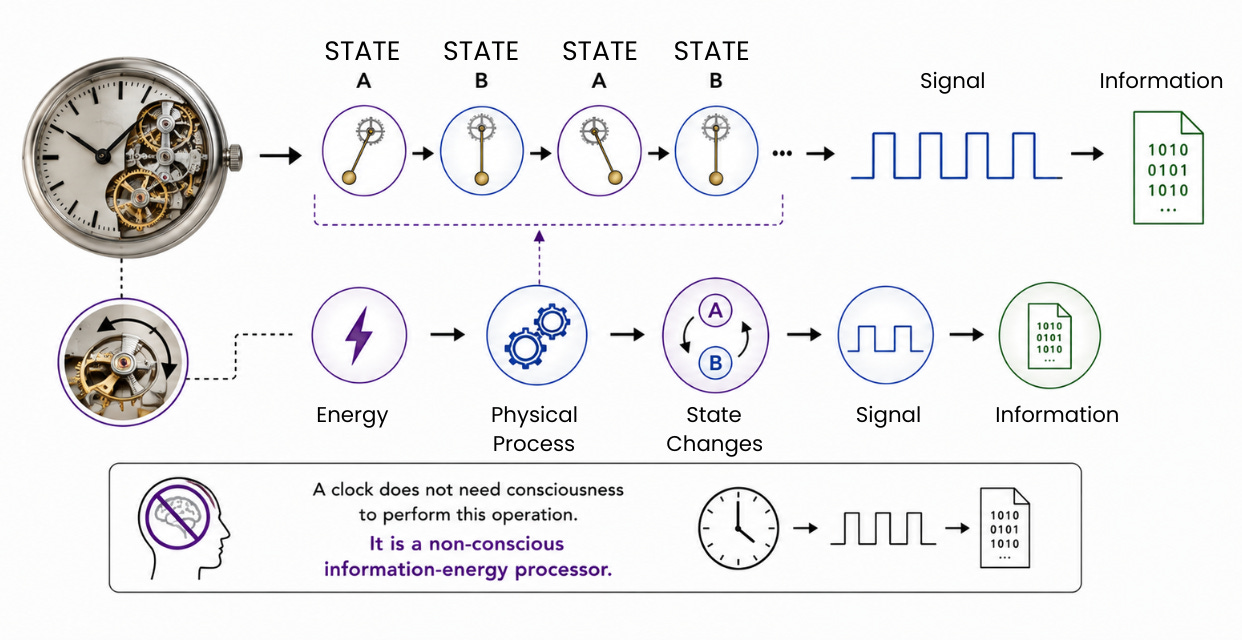
The clock’s physical process produces a recurring sequence of states:
State A → State B → State A → State B → ...
Those recurring changes can then be detected, counted, and converted into information. The process can therefore be represented as:
Energy → physical process → state changes → signal → information
A clock does not need consciousness to perform this operation. It is a non-conscious information-energy processor.
A Clock Doesn’t Measure Time Directly
Consider a mechanical clock. Energy is stored in a spring or weight. The escapement regulates its release. Charge, discharge. The pendulum or balance wheel oscillates. Each oscillation permits another controlled movement of the mechanism. The process therefore becomes:
Stored energy → regulated release → oscillation → discrete state changes → counted events
Those events eventually become a clock reading:
11:27:54
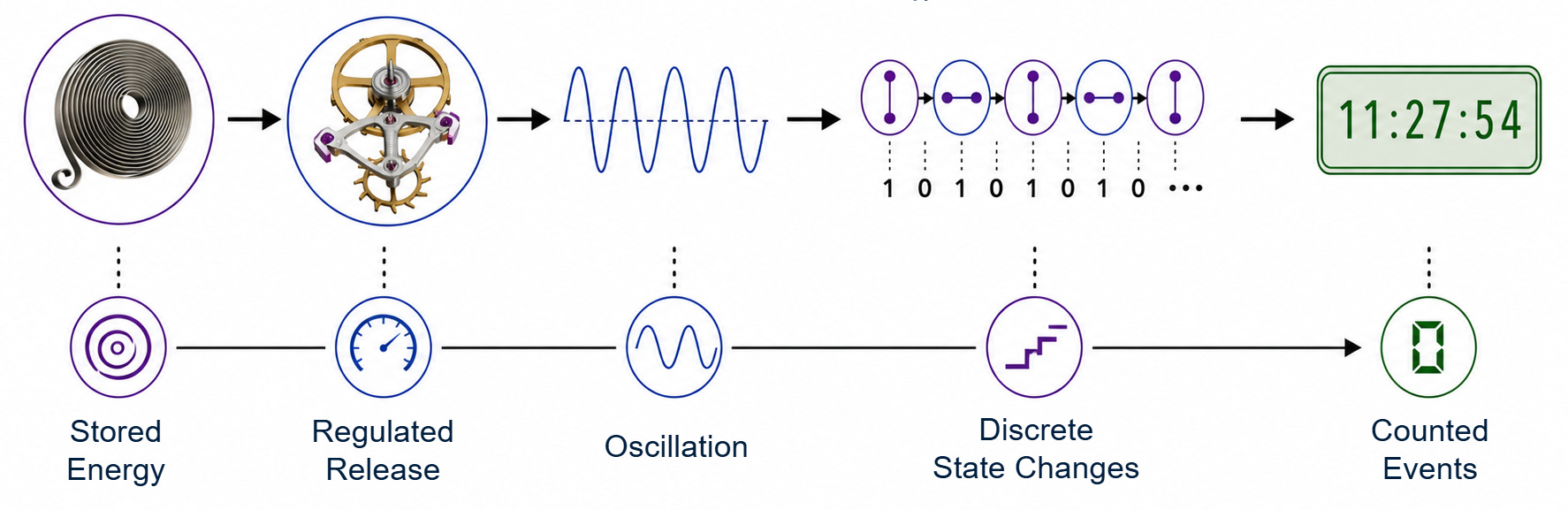
But nowhere in this process does the clock encounter a substance called time. It undergoes a succession of physical states. And this gives us another important distinction:
A clock does not measure time directly. It measures the behaviour of a physical process and provides a standardised representation of that behaviour.
A quartz clock makes the principle even clearer. Electrical energy drives the quartz oscillator. The crystal undergoes periodic deformation. Electronics detect the oscillation and divide its frequency down into regular pulses. Those pulses are counted and converted into a display. The process becomes:
Energy → Oscillation → Periodic Signal → Count → Temporal Information
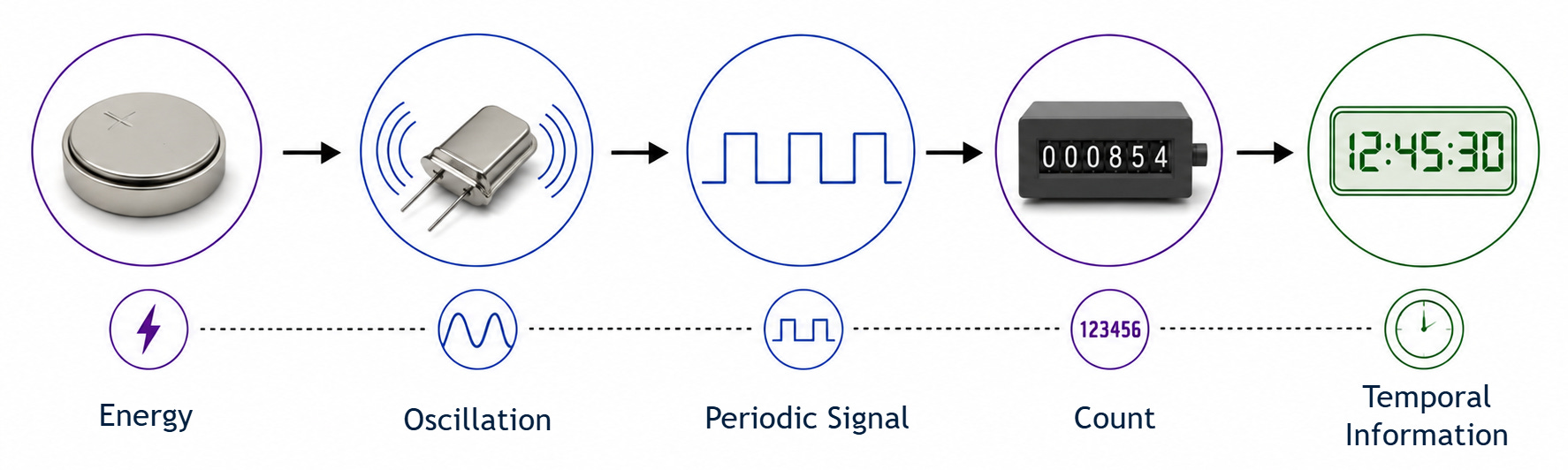
An atomic clock performs the same general function with a vastly more precise physical reference process. Again, there is no little time detector hidden inside it. There is a physical process.
Processor, Process; Rhythm, Rate
This gives us yet another useful PET distinction.
The processor is the organised physical system. The process is what the processor does. The rhythm is the recurring pattern produced by the process. The rate describes how rapidly that pattern recurs. The count converts recurrence into information. And the temporal measurement expresses the relationship between that process and another reference process. So:
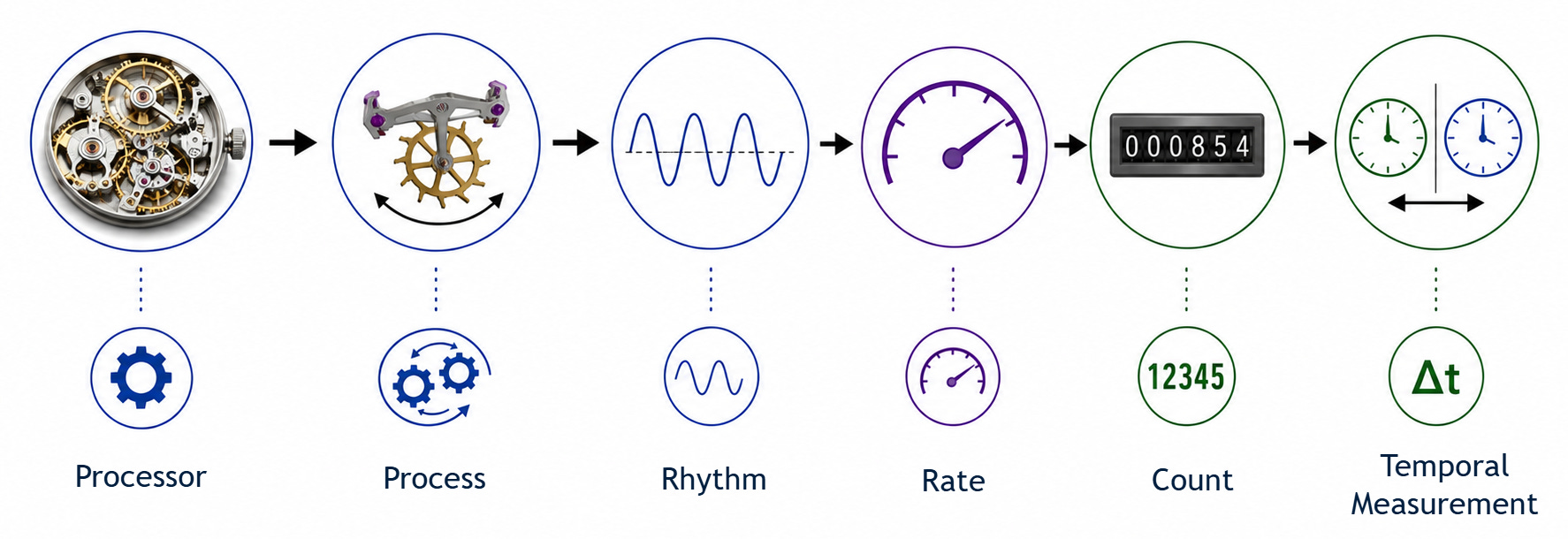
This is why the clock is so useful to PET. It gives us a simple physical example of a much broader proposition.
From Clock to Processor
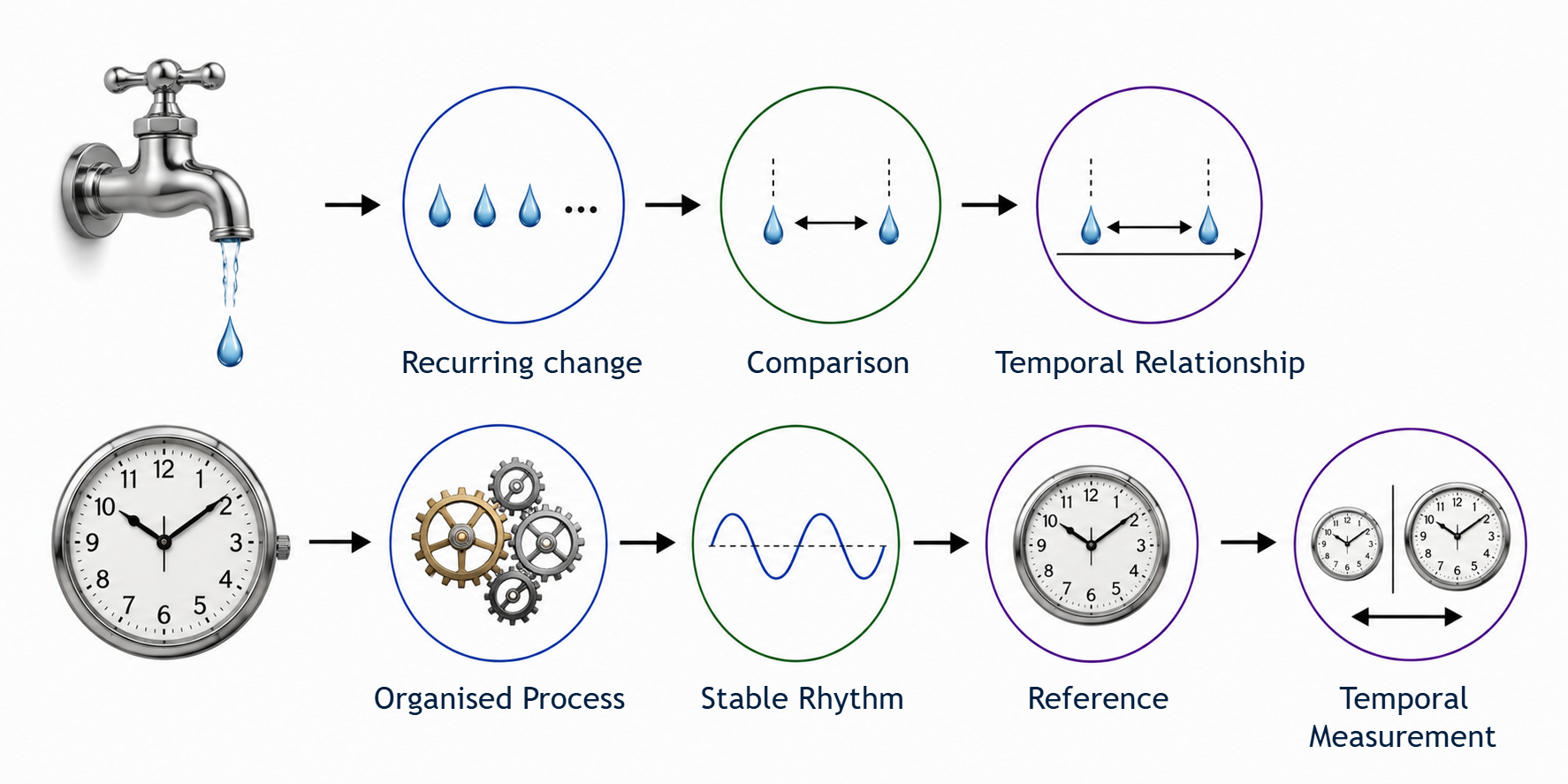
Armstrong’s faucet thought experiment showed us the relational character of temporal measurement. The clock gives us something more concrete. It provides a relatively stable physical process against which other processes can be compared. PET then asks what the faucet and the clock have in common.
Both involve physical processes undergoing recurring state changes.
The faucet gives us:
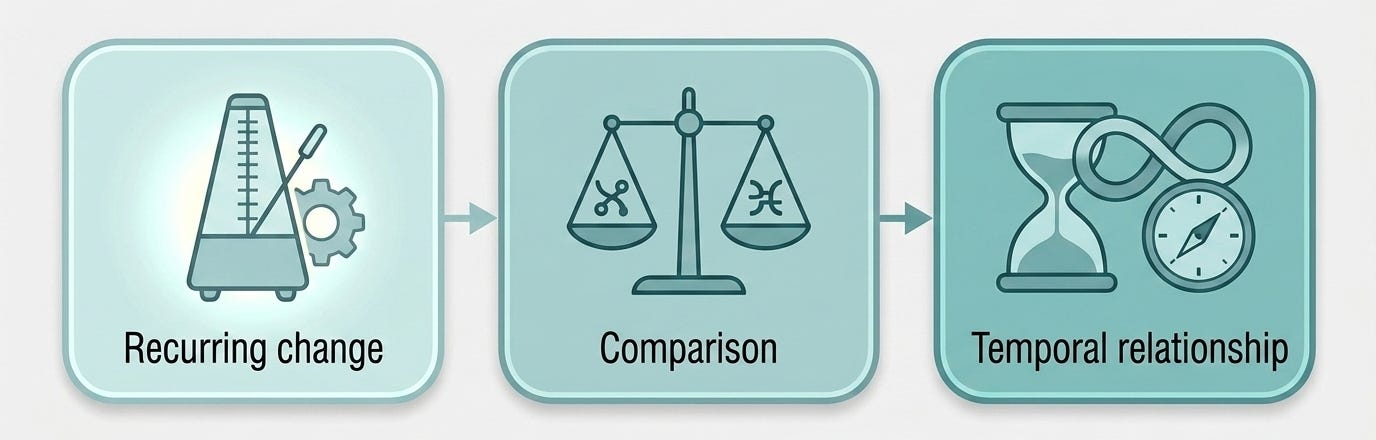
The clock gives us:
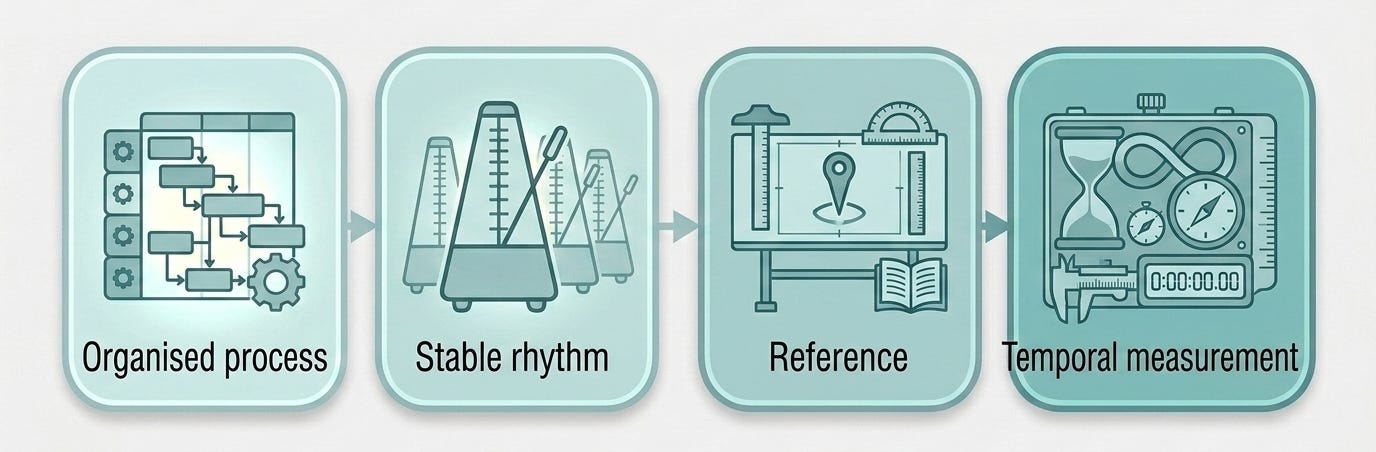
PET then takes the next step.
What if the clock is not a special exception?
What if recurring physical processes are a general property of organised systems?
What if every organised information-energy processor has its own characteristic rhythms?
That would mean that clocks are not fundamentally different from the systems whose processes they measure. They are simply highly engineered examples of stable processing rhythms.
Why Clocks Can Disagree
This also helps us understand why different clocks can produce different rates. A pendulum has one characteristic period. A quartz oscillator has another. An atomic transition has another. Change the physical conditions affecting the processor, and its behaviour can change.
This is precisely why I think the Earth-Moon-Mars comparison examined by Ashby and Patla is relevant to PET. Their calculations show that identical atomic clocks following different physical trajectories accumulate different amounts of proper time. Relativity describes this in terms of spacetime geometry and proper time. PET asks a different question:
What is happening to the physical processor and its characteristic rhythm under those different conditions?
That question does not necessarily invalidate the relativistic calculation. It asks us to look at the physical process from another conceptual level. Instead of asking only, “How does time behave differently for these clocks?” PET asks, “What happens to the information-energy processing that produces each clock’s reference rhythm under different physical conditions?”
The clock is therefore placed inside the phenomenon being measured, rather than treated as a passive observer of an independently existing temporal substance. The clock is, one way or another, a participant.
From Processing to Time
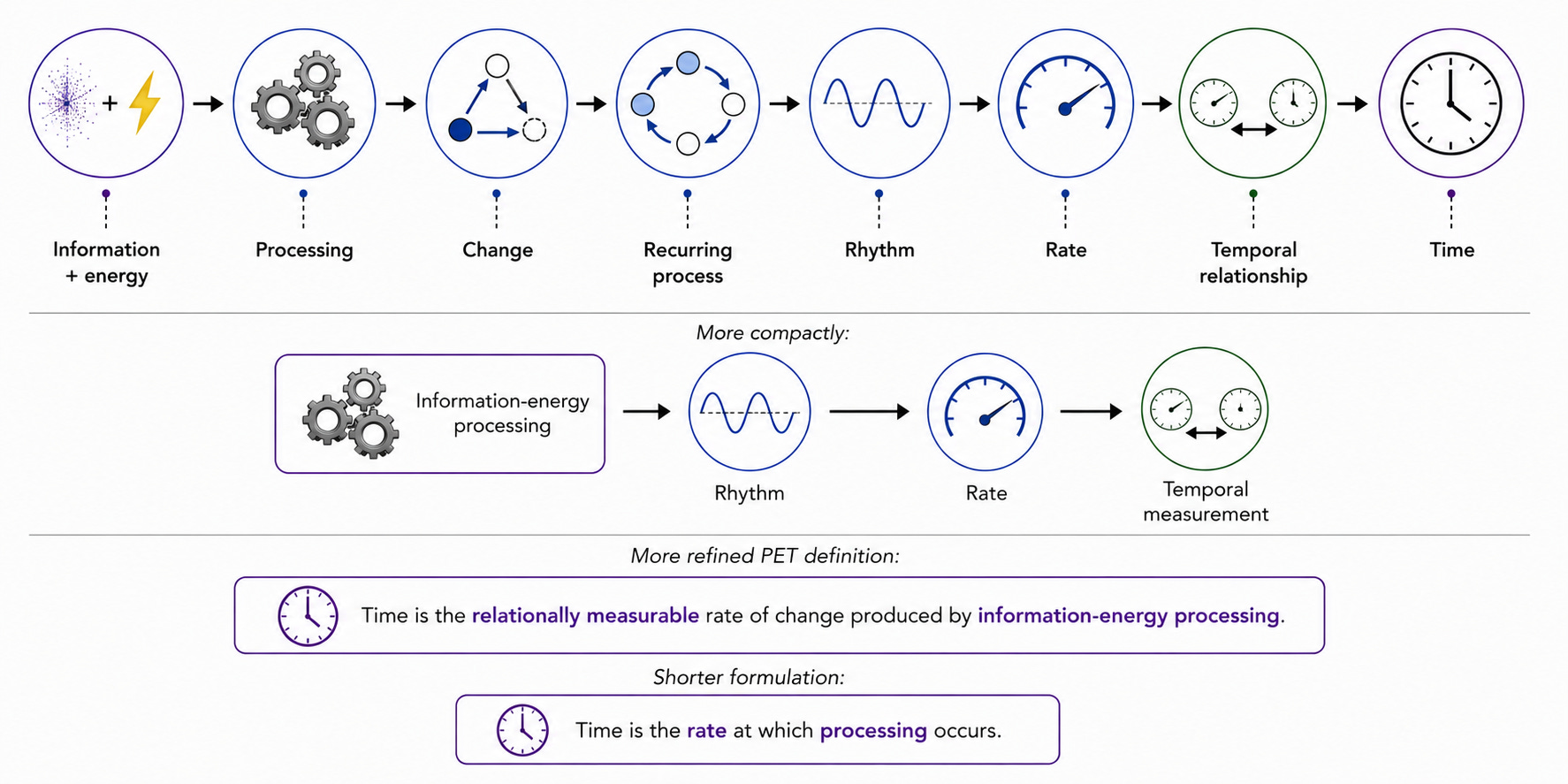
We can now make the PET sequence increasingly concrete. A processor receives and transforms energy. Its physical states change. Those changes can recur. Recurrence produces rhythm. Rhythm has a rate. That rate can be compared with other rates. The comparison produces temporal information. And so:
Information + energy → processing → change → recurring process → rhythm → rate → temporal relationship → time
Or, more compactly:
Information-energy processing → rhythm → rate → temporal measurement
This then gives us a more refined PET definition:
Time is the relationally measurable rate of change produced by information-energy processing.
And the shorter formulation remains:
Time is the rate at which processing occurs.
The two statements are complementary. The first emphasises change, relationship and measurement. The second connects time directly to the underlying process.
The Clock Is Not Time
This allows us to state several propositions quite plainly:
A clock does not create time. A clock does not contain time. A clock does not travel through time.
A clock is a physical processor whose relatively stable rhythm provides a reference for measuring temporal relationships. And that distinction may seem subtle, but it changes the question we are asking.
Instead of, “How does a clock measure time?” we can ask, “What physical process is the clock actually measuring?”
The answer is not an invisible temporal substance. It is a relationship between physical changes. The clock provides one particularly stable process against which other processes can be compared. And this is why the clock is such a useful bridge between the philosophy of time and PET. It takes an abstract question “What is time?” and places it on the desk in front of us.
We can open the clock. We can identify its energy source. We can identify its oscillator. We can observe its state transitions. We can count its signals. And we can compare its rhythm with another process.
Nothing mysterious has been added. There is simply organised physical processing.
The Bigger Question
But the clock also creates a much bigger question. A clock is an engineered processor designed to maintain a relatively stable rhythm. And so…
What happens when the processor is not a clock?
What happens when it is a cell?
An organ?
An organism?
A nervous system?
A planetary system?
Each contains processes within processes. Each receives information-energy from its surroundings. Each transforms it. Each stores the consequences of previous states. Each generates new states. Each possesses characteristic rhythms. And each exists within larger rhythms while containing smaller ones.
If that is correct, then the clock is not the beginning of the story. It is merely our clearest example of the principle.
The more pertinent PET question is now:
If every organised information-energy processor generates characteristic rhythms, what happens when the processor becomes sufficiently complex to process information about itself as well as its environment?
That is where the question of time begins to meet the question of consciousness.


Matryoshka Clocks
Nested Time
If every organised processor has characteristic rhythms, then time does not exist at only one scale. A cell has processes occurring within it. An organism contains cells while coordinating processes occurring across organs. A planet contains organisms while participating in larger environmental processes. The result is a hierarchy of processes within processes.
We can represent it simply:
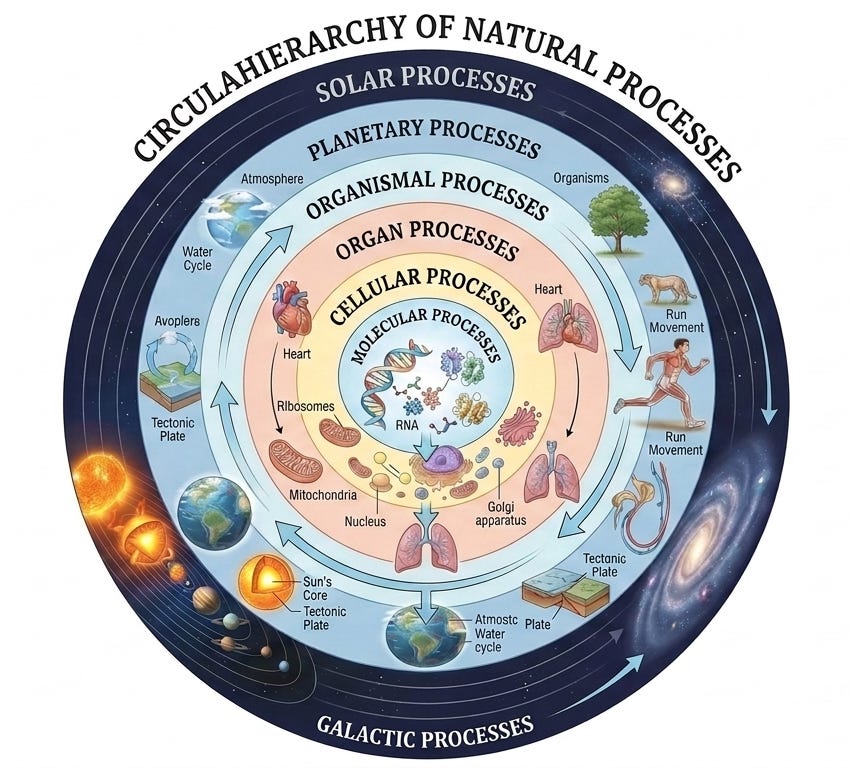
Each level has characteristic rhythms. But no level exists independently of the others.
A molecule participates in cellular processes. A cell participates in the organisation of an organ. An organ participates in the functioning of an organism. An organism participates in the processes of its environment. A planet participates in the electromagnetic and plasma environment of its star. A stellar system participates in larger galactic processes.
The structure is therefore rather like a set of nested containers, albeit with one important difference. These are not passive containers. They are nested processors. And each contains smaller processes while simultaneously participating in larger ones.
A Cell Has Its Own Rhythms
Consider a single cell. Its molecular machinery operates through countless processes occurring at different rates. Membranes maintain electrical gradients. Molecules are synthesised and broken down. Proteins change configuration. Ions move across membranes. Energy is transferred and stored. Signals are received and transmitted.
These processes do not all occur at the same rate. Some happen extraordinarily rapidly. Others unfold over seconds, minutes, hours, or longer.
The cell therefore does not possess one simple rhythm. It contains a hierarchy of rhythms interacting with one another. Yet the cell itself also participates in larger rhythms. Its behaviour contributes to the functioning of a tissue. The tissue contributes to an organ. The organ contributes to an organism. The organism introduces another level of organisation and another collection of characteristic alternations and rhythms.
The Organism Is Not an Isolated Clock
A human organism, for example, contains countless interacting cycles. There are cellular processes. Metabolic processes. Electrical processes. Neural processes. Cardiovascular processes. Respiratory processes. Sleep-wake rhythms. And many others.
These rhythms are neither completely independent nor perfectly synchronised. They interact. One process can influence another. A change at one level can propagate through the system. The organism therefore possesses its own temporal character without possessing only one “clock”. It is a collection of nested processors whose rhythms are continually interacting.
This is, once again, an important distinction. When we say that an organism has a particular temporal rhythm, we are describing the behaviour of a whole system, not claiming that every process within it operates at exactly the same rate.
The Planet Is Another Processor
The same principle can be extended beyond biology. For instance, Earth contains an extraordinary hierarchy of physical processes. Molecular processes occur within organisms. Organisms interact within ecosystems. Ecosystems participate in planetary environmental processes.
The planet rotates. Its atmosphere circulates. Its oceans move. Its electromagnetic environment changes. Its plasma environment interacts with the surrounding heliospheric environment. Each process has characteristic rates. And each exists within relationships with processes operating at other scales.
Earth therefore participates in larger rhythms while containing smaller ones. Its rotation provides one recurring planetary process. Its orbit provides another. Seasonal cycles emerge from their relationship. Biological systems respond to these larger cycles while simultaneously generating rhythms of their own.
The nested structure continues.
From Planet to Star
The same reasoning can be extended outward.
A planet exists within the environment of its star. The star has its own processes and characteristic rhythms. Its plasma continually moves. Magnetic structures form and change. Energy is transported through its interior and atmosphere. Its activity varies over different timescales.
The planetary system therefore exists within a larger information-energy environment whose changing conditions can influence the processes occurring within it. And the star itself exists within a galactic environment. The solar system participates in larger-scale galactic processes just as an organism participates in planetary processes.
The hierarchy therefore continues outward:
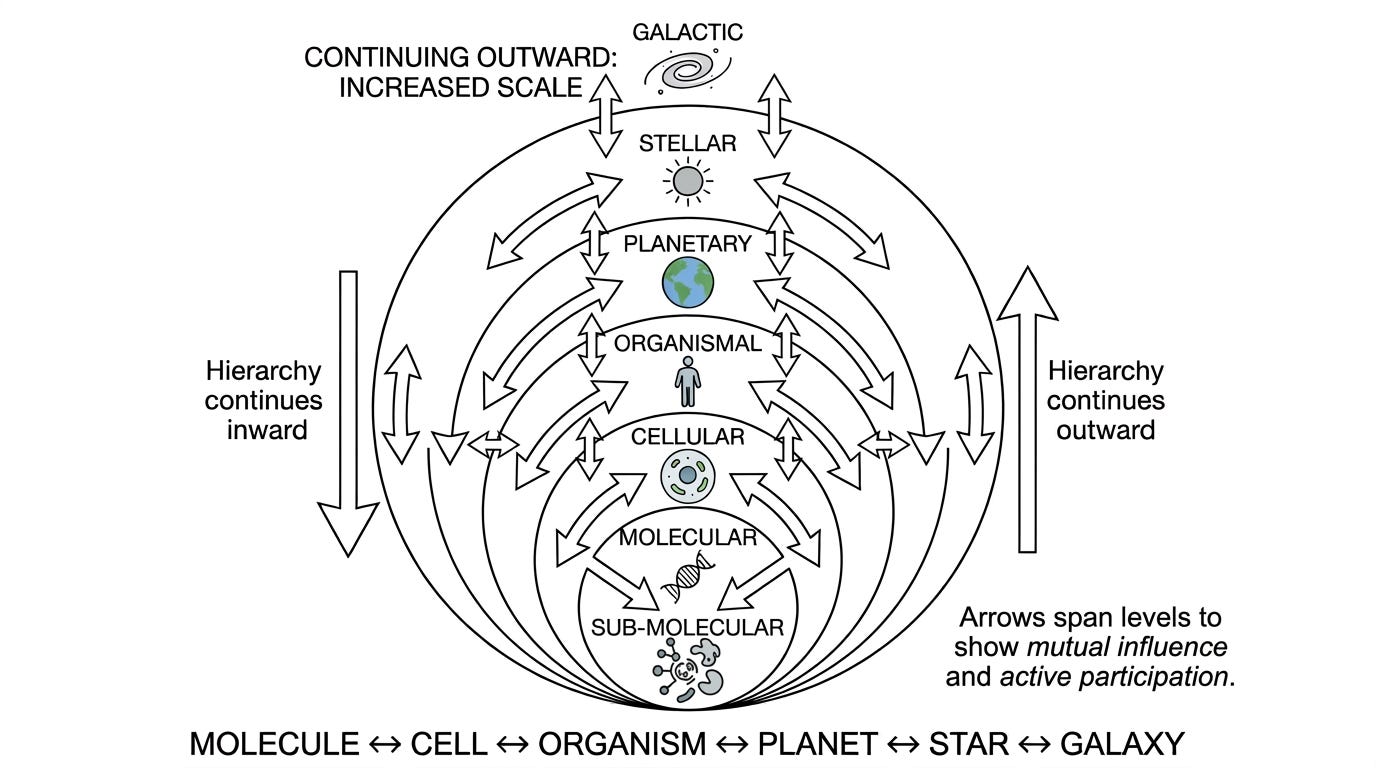
But it also continues inward. Every level contains processes operating at smaller scales.
Time Is Nested Because Processing Is Nested
This leads to one of the more distinctive propositions of PET:
Time is nested because processing is nested.
If time is related to the rate of organised processing, and organised processing occurs across nested levels of reality, then temporal relationships must also exist across those levels.
A cellular process has its own rate. The organism has characteristic rates emerging from the coordination of many cellular and organ-level processes. A planet has characteristic rates emerging from planetary processes. A star has characteristic rates emerging from stellar processes.
None of these rates exists in isolation. Each processor participates in larger processes while containing smaller ones. This means that there need not be one privileged operational clock governing every level of material reality. Instead, there is a hierarchy of rhythms and relationships between rhythms.
Not Many Separate Times
This does not necessarily mean that there are completely separate “times” for molecules, cells, organisms, planets and galaxies. That would simply replace one universal time with a collection of disconnected times.
PET proposes something more relational.
There are different characteristic processing rates, embedded within one another and continually interacting. A cell does not stop participating in the organism simply because its molecular processes operate at a different rate. An organism does not stop participating in planetary processes because its biological rhythms differ from planetary cycles. The processes coexist. They interact. They constrain one another. They entrain one another under suitable conditions.
The temporal structure is therefore nested and relational, rather than fragmented into isolated temporal worlds.
The Matryoshka Analogy
This is why the image of a set of Matryoshka dolls is useful. A smaller doll sits inside a larger one. That doll sits inside another. And so on.
But PET’s nested processors are more dynamic. Each level is both inside another system and participating in it. A cell exists within an organism. The organism exists within an environment. The environment exists within a planetary system. The planetary system exists within a stellar environment. And the stellar environment exists within a galactic environment.
At every level, processes are occurring. At every level, information-energy is being received, transformed, stored, and transmitted. At every level, rhythms emerge. And at every level, those rhythms interact with rhythms above and below them.
This gives us a more precise way to describe nested time:
Each processor has characteristic temporal rhythms arising from its own organised processing, while simultaneously participating in the temporal rhythms of the larger and smaller processors with which it is coupled.
From Nested Rhythms to Temporal Perspective
This also helps explain why different processors can have different temporal perspectives without requiring time itself to be a separate substance.
A molecular process does not operate at the same rate as a heartbeat. A heartbeat does not operate at the same rate as Earth’s rotation. Earth’s rotation does not operate at the same rate as the solar cycle. The solar cycle does not operate at the same rate as a galactic process. Yet these processes can remain physically related.
The difference is not necessarily that one processor has “more time” than another. They have different characteristic rates of processing. And when those rates interact, temporal relationships emerge.
This returns us to the central PET formulation:
Time is the relationally measurable rate of change within and between information-energy processes.
The phrase within and between is important. Time is not merely a property of an isolated processor. It is also expressed through relationships between processors. When a processor changes internally, it also changes in relation to the systems around it. Its rhythms are therefore both intrinsic and relational.
The Nested Clock
A conventional clock gives us a deliberately simplified example. It isolates a relatively stable physical rhythm so that we can compare it with other processes. A biological system is different. It is more like a clock containing clocks containing clocks.
The molecular processes generate cellular rhythms. Cellular rhythms contribute to organ rhythms. Organ rhythms contribute to organismal rhythms. The organism interacts with environmental rhythms. Environmental rhythms are embedded within planetary rhythms. Planetary rhythms are embedded within solar rhythms. And so the hierarchy continues.
The “clock” is therefore no longer a single device. It is the entire processor hierarchy. And this is where the concept of nested time becomes more than an analogy. It follows directly from the PET premise that organised information-energy processing occurs at multiple interconnected levels.
Processing is nested. Rhythms are nested. Temporal relationships are nested.
Therefore, time is nested because processing is nested.
And this raises the next question:
If every processor has characteristic rhythms, and those rhythms are influenced by the processors and environments surrounding them, then what happens when the environment changes the processor itself?
That is where temporal rate becomes dynamic rather than merely descriptive.


As Above, So Below
Environment Changes the Processor
A processor does not exist in isolation. Every organised information-energy processor is embedded within a larger environment containing other processors, fields, currents, oscillations, and information-energy reservoirs. Its internal rhythm is therefore not necessarily determined entirely from within.
The processor receives information-energy from its environment. It processes that input according to its existing organisation. It changes state. And its changed state alters how it interacts with the environment. The environment changes the processor. The processor, in turn, changes its relationship with the environment. And this creates a continuous reciprocal relationship:
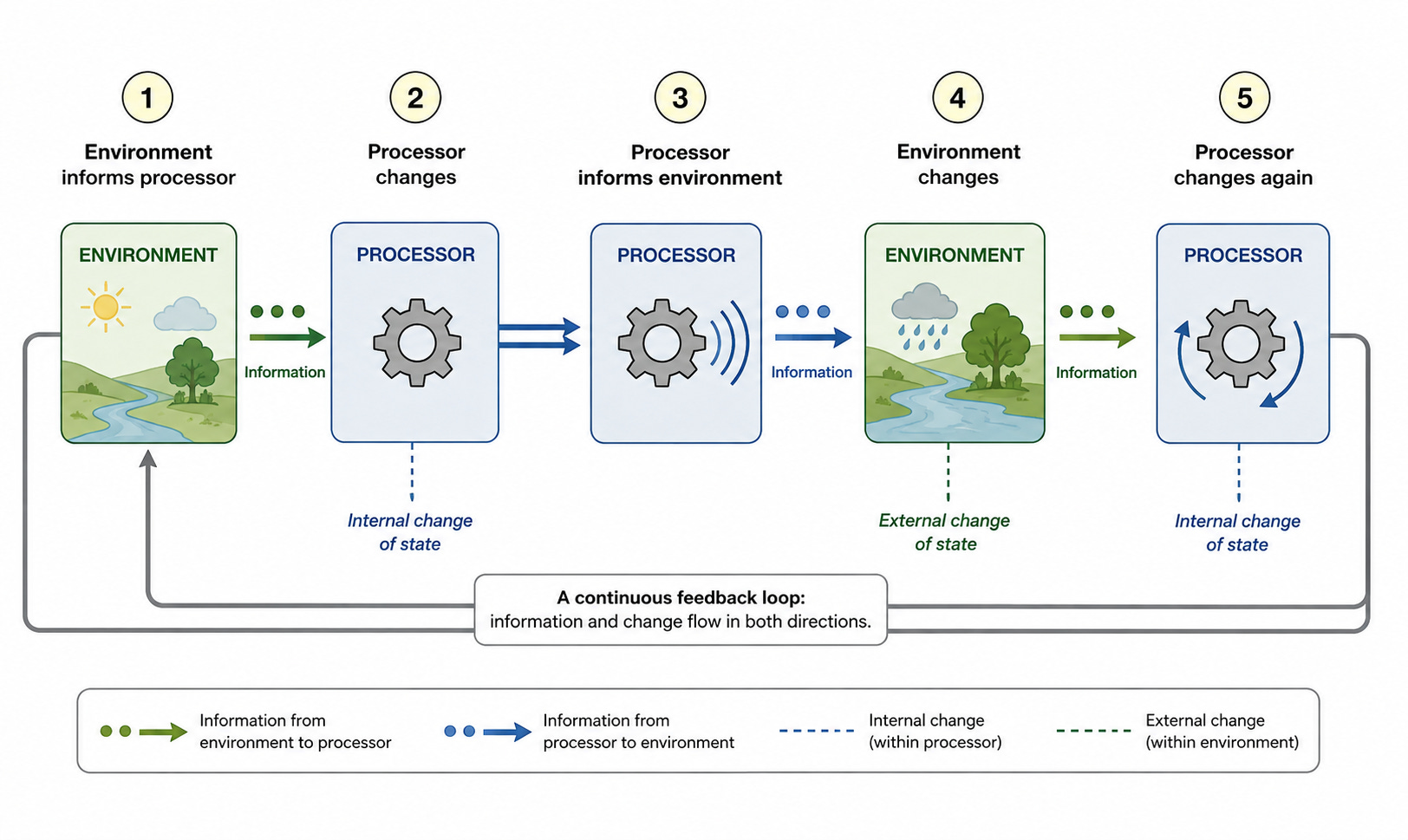
And the cycle continues…
Environmental fields
Within PET, environmental influences can include electromagnetic fields, plasma conditions, electric potentials, charge distributions, magnetic-field configurations, radiation, temperature, chemical interactions, and biological interactions.
These should not all be treated as equivalent effects, nor does PET claim that every proposed influence has already been demonstrated. The more fundamental proposition is simpler:
A processor is embedded within an information-energy environment, and information-energy from that environment can influence its organisation and processing.
Within the plasma-cosmological interpretation developed here, electromagnetic and plasma phenomena are particularly important because they provide mechanisms through which information and energy can be transferred between systems.
The environment is therefore not merely a backdrop against which the processor operates. It is part of the processor’s ongoing informational and energetic context.
The Processor Is Changed By What It Receives
A processor does not respond to every environmental input in exactly the same way. Its response depends upon its existing organisation. The same environmental change may produce different outcomes in differently organised processors.
This is where the predictive aspect of PET becomes important. The processor enters each cycle carrying the organisation produced by previous cycles. That organisation determines what information-energy it can receive, how it can process that information-energy, and which responses are available to it.
The environment modifies those constraints. But it does not necessarily erase them. This then gives us a useful relationship:
Existing organisation constrains possible responses. Environmental information-energy modifies those constraints. Processing produces a new organisation. The new organisation changes the possibilities available during the next cycle.
The processor is therefore neither completely determined by its environment nor completely independent of it. It is continuously being shaped through interaction.
Murphy’s Principle Enters Here
This provides a natural role for Murphy’s Principle. The organisation of a processor constrains the futures available to it. At any particular moment, not every possible future is equally accessible. The processor’s current configuration determines which transitions are possible, which are constrained and which are effectively unavailable.
But those constraints are not necessarily permanent. Environmental information-energy continually modifies the processor. Processing changes its organisation. Recalibration updates its configuration. The next cycle therefore begins with a modified set of possibilities. Murphy’s Principle can consequently be expressed in temporal terms:
The organisation of a processor constrains the futures available to it, while its environment continually modifies those constraints.
The future is therefore neither completely predetermined nor completely arbitrary. It emerges from the interaction between what the processor has become and what its environment presents to it.
Environment Changes Temporal Rhythm
This becomes particularly important for the PET conception of time, with the four-phase sequence remaining ordered:
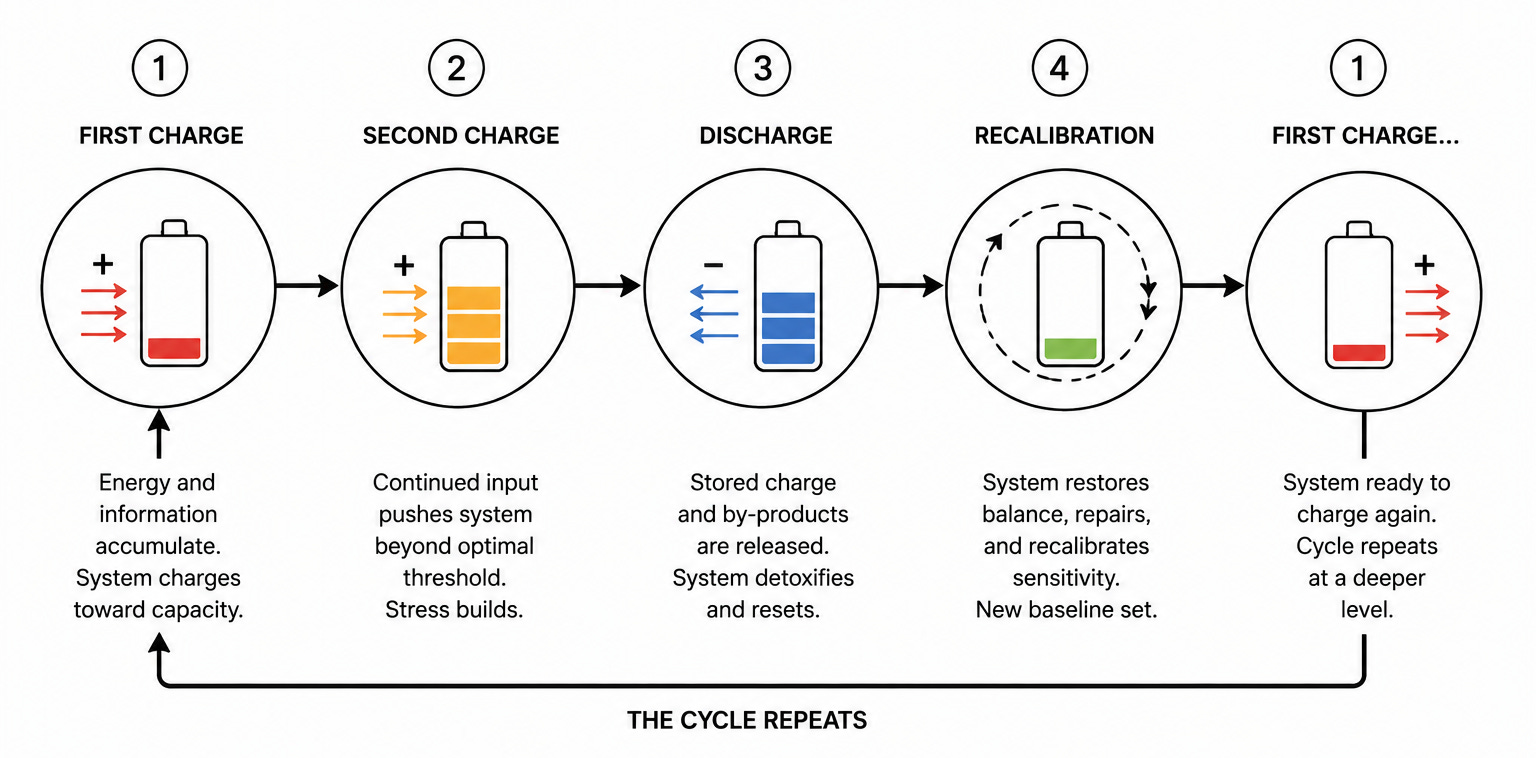
That sequence cannot simply be rearranged. But the characteristics of the cycle can change. Environmental information-energy can influence the rate at which charge accumulates. It can influence the conditions under which a threshold is reached. It can influence the intensity of discharge. And it can influence the process of recalibration.
Consequently, the characteristic rhythm of the processor can change. The sequence remains linear. The recurrence remains cyclical. But the rate of the cycle can vary. This then gives us another important refinement:
A processor’s temporal rate is not necessarily determined by the processor alone. It emerges from the relationship between its organisation and the environment in which it processes information-energy.
That does not mean that the environment determines the processor’s time. Influence is not determination. The processor retains its own organisation and internal dynamics while continuously interacting with its surroundings.
As Above, So Below
This is where the nested structure becomes particularly interesting. A cell exists within an organ. An organ exists within an organism. An organism exists within an ecosystem. An ecosystem exists within a planetary environment. A planet exists within a solar environment. A solar system exists within a galactic environment. At every level, the larger system influences the organisation and rhythms of the smaller systems within it.
But the relationship also operates in the opposite direction. The smaller processor contributes to the behaviour of the larger system. The cell contributes to the organism. The organism contributes to the ecosystem. The ecosystem contributes to planetary processes. And the planet contributes to the larger planetary environment. The relationship is therefore reciprocal rather than strictly top-down.
“As above, so below.” And equally, “As below, so above.”
Every level is simultaneously influenced by larger processes and contributes to them.
Temporal Ecology
This produces what might be called a temporal ecology.
A processor has its own characteristic rhythm, but that rhythm exists within a network of other rhythms. Some rhythms are faster. Some are slower. Some interact directly. Others influence one another indirectly through larger systems. Some become synchronised. Others remain relatively independent.
The important point is that none exists in complete isolation. The temporal character of a processor is therefore relational at two levels. It arises from its internal processing. And it is continually modified through its relationship with external processing. And this returns us to the central PET definition:
Time is the relationally measurable rate of change within and between information-energy processes.
Once again, the words within and between are doing the important work. Time is not merely the rate of an isolated internal process. Nor is it merely a relationship imposed from outside. It is expressed through the changing relationships between organised processes.
The Processor & Its Environment Form a Continuing Cycle
We can now extend the four-phase cycle beyond the individual processor:
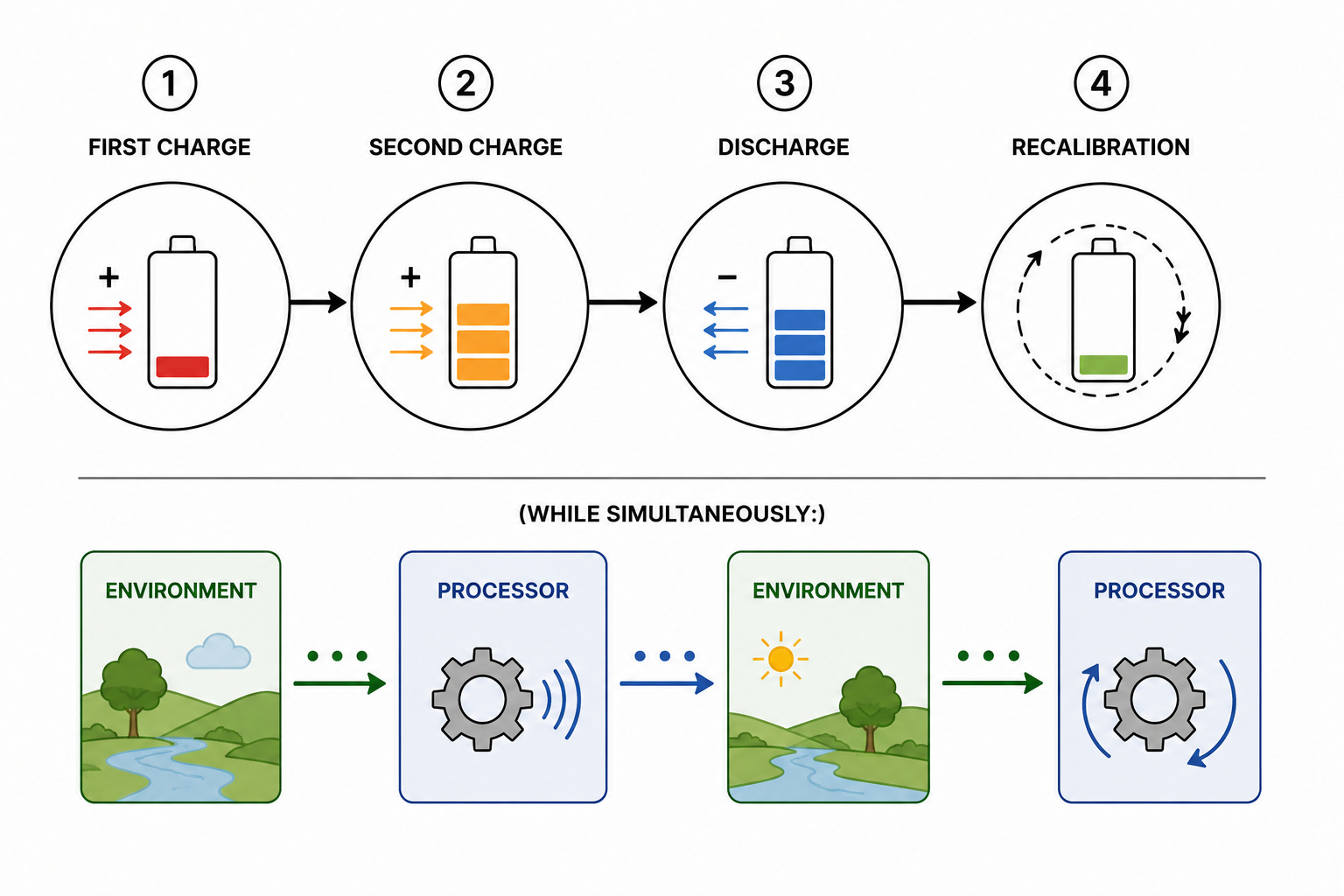
The processor receives. It processes. It responds. Its response alters the relationship. The altered relationship produces new information-energy. The processor receives again. The cycle continues.
This is Dual Supersession operating across the boundary between a processor and its environment. The boundary itself is therefore not an absolute separation. It is an interface through which information and energy continually pass. And as that exchange continues, both the processor and its environment can change.
This is why the PET conception of time is inseparable from process. A processor’s temporal rate cannot be understood completely apart from the processes with which it interacts.
Change produces succession. Recurrence produces rhythm. Rhythm produces rate. Environmental interaction modifies the rate. And comparison between rates produces temporal relationship.
And from there, we arrive again at time. The next question is therefore unavoidable:
If the environment can influence the rhythm of a processor, what happens when the processor itself becomes sufficiently organised to process not only its environment, but information about its own processing?
That is where the path from time now leads directly and unavoidably towards consciousness.


What Is Consciousness?
Now We Arrive at Consciousness
We have followed the question of time from clocks to processes, from processes to change, from change to cycles, and from cycles to rhythms and rates. We have also seen that no processor exists in complete isolation. Every processor receives information-energy from its environment, processes it according to its existing organisation, changes state, and responds.
But what happens when a processor begins processing information about itself as well as information about its environment?
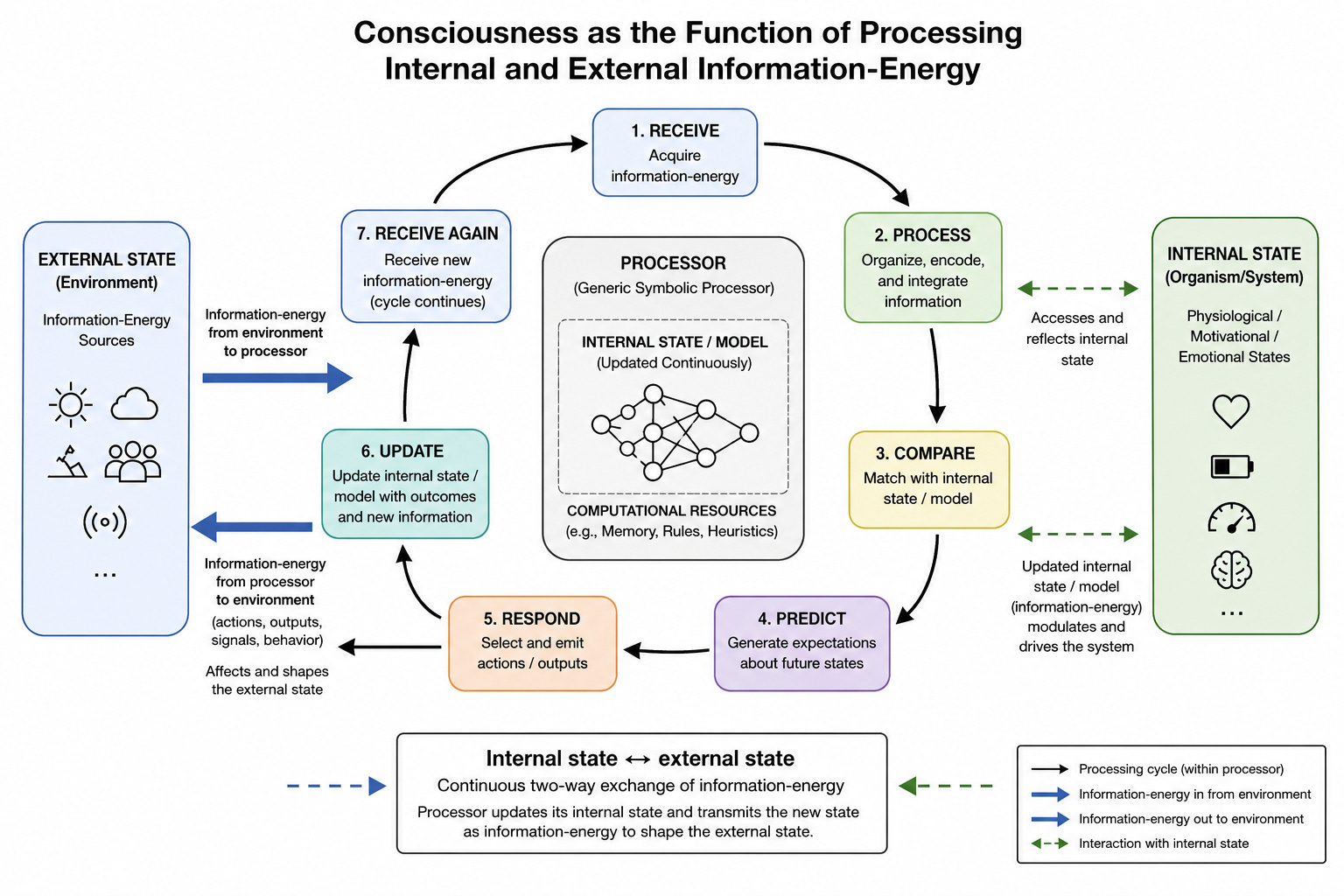
This is where consciousness enters the picture. A processor can receive information about its internal condition while simultaneously receiving information from outside itself. It can, in principle, compare:
Internal state ↔ external state
It can retain information about previous states. It can evaluate incoming information against that accumulated organisation. It can anticipate possible outcomes. It can generate predictions. It can modify its own behaviour. And it can act upon its environment. And the consequences of that action become new information. The cycle then begins again.
Receive → process → compare → predict → respond → update → receive again
The processor is no longer simply undergoing change. Its processing now incorporates information about the changes occurring within itself and around it.
From Processing to Awareness
This provides the basis for the PET conception of consciousness. It is not treated as a substance hidden inside the processor. It is not a separate material component. Nor is it an immaterial entity operating independently of physical processes. It is a function of the processor’s organised activity.
The processor processes information-energy. It integrates information about its internal state with information received from its environment. It retains information from previous states. It evaluates present conditions. It generates possible future states. It responds. It updates. And it repeats.
From this perspective:
Consciousness is the function of processing information and energy.
The definition is deliberately functional. It describes what consciousness does, rather than treating consciousness as a thing that must somehow be added to an otherwise unconscious material reality.
Self & Environment
An important consequence follows. Self-awareness and environmental awareness are not necessarily two completely separate phenomena. A processor cannot meaningfully process information about itself without some distinction between its internal state and what lies beyond it.
Likewise, processing environmental information depends upon the processor’s own organisation. The two therefore develop together:
Internal information ↔ external information
The processor continuously compares the two. Its internal organisation influences how it interprets external information. External information modifies its internal organisation. The distinction between self and environment therefore becomes an active informational relationship rather than an absolute separation.
Memory & Prediction
This also connects consciousness directly to the temporal framework developed earlier. The processor does not begin every cycle from nothing. Recalibration carries information forward. Previous organisation influences present processing. Present processing generates predictions about possible future states. Those predictions constrain subsequent responses.
Once a predicted possibility becomes an actual state, that state becomes part of the processor’s accumulated information. Thus:
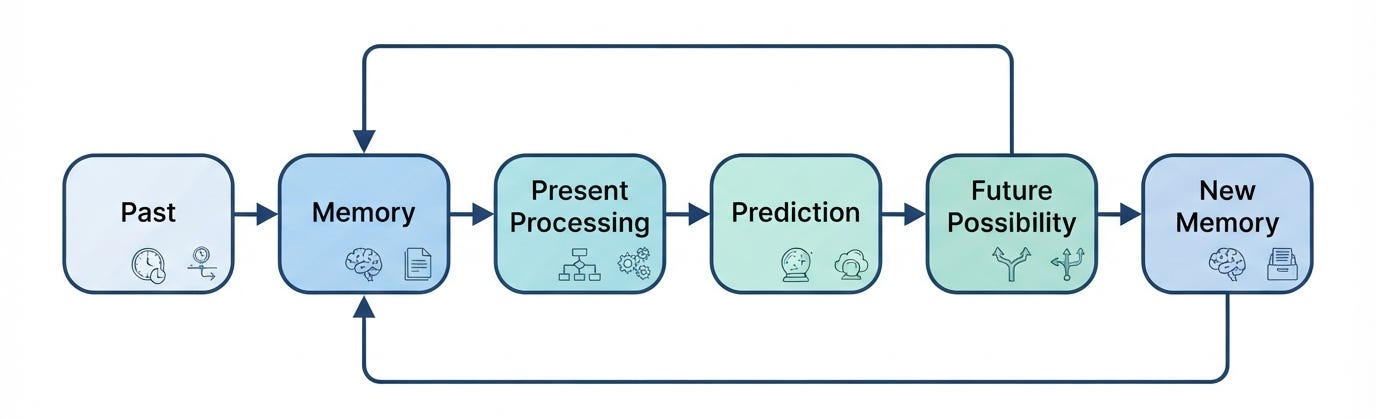
The future is not simply waiting somewhere ahead. It is continually being generated as a set of possibilities by the processor’s present organisation and its interaction with the environment. And this is why consciousness and time can be connected without being confused with one another.
The conscious processor processes information about what has been, what is happening, and what might happen next. Its processing therefore has a temporal structure. But this does not mean that consciousness itself is time.
Consciousness & Time
PET therefore makes a clear distinction between the two:
Consciousness = what processing does.
Time = the rate at which processing occurs.
Consciousness describes the function. Time describes the rate. The two emerge from the same organised information-energy processing, but they are not the same property. A processor can have a characteristic processing rate without possessing the sophisticated self-referential integration associated with human-like consciousness.
PET therefore does not need to claim that every structure, including clocks, is conscious in the same sense that a human being is conscious. The important proposition is that processing precedes the richer forms of consciousness we recognise.
As processing becomes more integrated, recursive and capable of incorporating information about the processor itself, increasingly sophisticated forms of awareness can emerge. Such as human-like self-awareness.
Consciousness As Continual Processing
Consciousness is therefore not a static state that a processor possesses once and then retains unchanged. It is an ongoing function.
The processor continually receives. It continually processes. It continually compares. It continually updates. It continually predicts. It continually responds. And through that continual processing, it maintains and modifies its own organisation.
This returns us to the four-phase cycle:
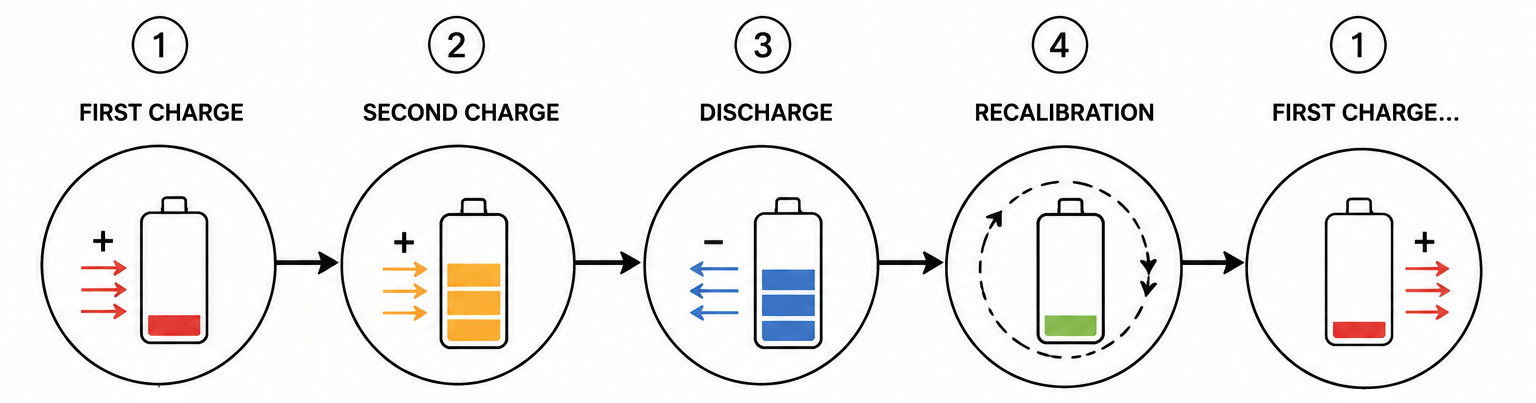
The processor accumulates. It reaches thresholds. It expresses stored charge. It recalibrates. And the updated organisation becomes the starting condition for the next cycle. Conscious processing therefore takes place within the same recurring architecture as every other organised information-energy process.
The difference is the richness and integration of the processing.
A Continuum Rather Than a Switch
This also opens the possibility that consciousness is not best understood as a simple switch:
Conscious or Unconscious
Instead, increasingly complex organisation can produce increasingly complex forms of information integration and awareness.
A simple processor may respond to a limited range of information. A more complex processor can integrate information from many internal and external sources. An even more complex processor can retain extensive memories, generate sophisticated predictions, model its own behaviour, and modify its environment.
The richness of consciousness therefore corresponds, within PET, to the richness of information-energy processing. This does not by itself establish how consciousness emerges in every physical system. That remains an open question. But it provides the conceptual direction:
Where organised information-energy processing becomes increasingly integrated, recursive and self-referential, increasingly sophisticated forms of consciousness emerge.
The Same Foundation, Different Properties
We can now see why time and consciousness have appeared together in this investigation. They originate from the same underlying process:
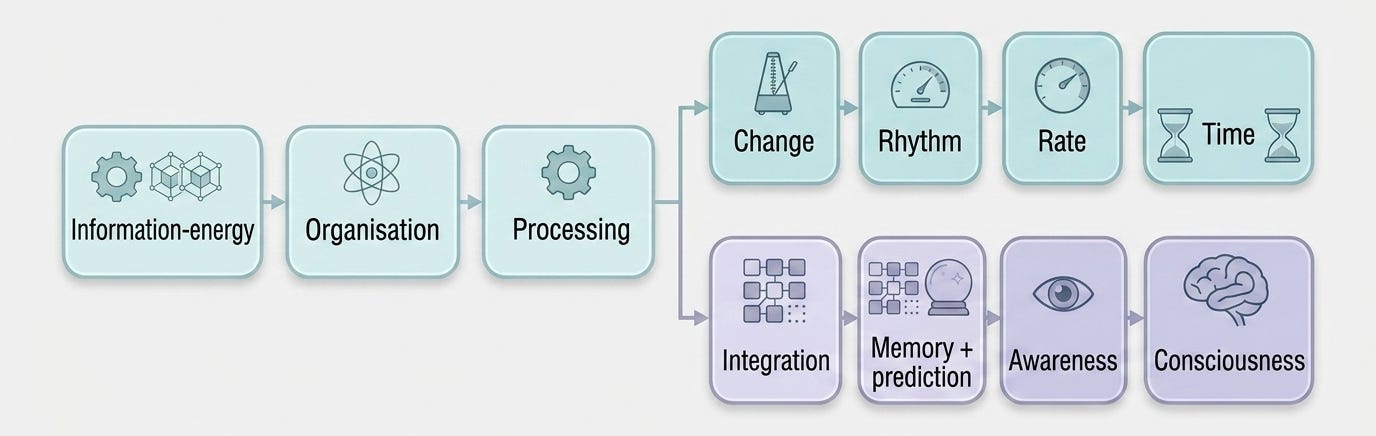
The two paths intersect at processing. But they then describe different properties of that processing. Time concerns rate. Consciousness concerns function. Neither needs to be introduced as a substance. Neither needs to exist as a container. Neither needs to be imagined as a separate thing added to material reality. They are properties that emerge from organised information-energy processing. And so this brings us to the final question.
If consciousness is the function of processing information and energy, and time is the rate at which that processing occurs, then perhaps the deepest question is no longer whether consciousness exists within time. Maybe both consciousness and time emerge from something more fundamental:
The process itself.


Before Time, There Is Alternation
Part Two has taken the argument from change to rhythm, and from rhythm to the relationships between processes. We have examined clocks as physical processes, considered how recurrence becomes measurable rate, and explored how those processes exist within nested systems whose environments can influence their rhythms. We have also begun to connect processing with consciousness, suggesting that increasingly integrated information-energy processing gives rise to increasingly complex forms of awareness.
The argument has therefore moved from the question of how change becomes measurable to the question of how different processes establish temporal relationships. But there is another relationship we have yet to examine:
The one between time and the observer.
If time emerges from the rates of processes, what happens when the process doing the observing changes its own rate of processing?
Why can the same measured interval seem to pass quickly in one circumstance and painfully slowly in another?
What role do memory, attention, prediction, and anticipation play in our experience of temporal passage?
And if the past is no longer a process occurring now, while the future is not yet an actualised process at all, what exactly would it mean to travel to either one?
Part Three turns inward, in a way. It takes the temporal relationships developed here and examines them from the perspective of the conscious processor, where time becomes not merely something measured, but something remembered, anticipated, experienced, and questioned.
Open Time
Thank you for taking the time to follow this second part of the journey. I hope the ideas have given you something worth thinking about, even where you may disagree with me. There is one final part still to come, where the framework turns more directly toward the experience and implications of time. As always, I welcome your feedback, insights, thoughts, questions, and especially your own experiences.
Before Time, There Is Change

What is Time? Part One traces the argument from change and succession through recurrence, rhythm, and rate, proposing that what we call time emerges from the measurable relationships between processes rather than existing independently of them.
Before Time, There Is Perspective

What is Time? Part 3.1 explores time from the perspective of the processor, examining why the same interval can feel different, how memory and prediction shape our experience of past, present, and future, and what this means for ideas such as time travel and predetermined possibility. It argues that the past is better understood as accumulated information, the future as constrained possibility, and the present as the active point where the two interact, suggesting that our experience of time emerges from processing rather than from travelling through a pre-existing temporal dimension.
Before Time, There Is Relationship

What is Time? Part 3.2 brings the journey into my PET framework, connecting time and consciousness to information-energy processing, memory, prediction, and human behaviour. It concludes that time and consciousness are not things, but different properties of organised processing shaped by the relationships between past, present, future, processor, and environment.
Further Reading


References
Michael Armstrong — “What Is Time?” | The Thunderbolts Project — Armstrong’s presentation questioning conventional assumptions about the nature of time. Michael Armstrong: What Is Time? — Thunderbolts Project
Neil Ashby & Bijunath R. Patla — “A Comparative Study of Time on Mars with Lunar and Terrestrial Clocks” — The Astronomical Journal (2026), examining relativistic proper-time differences between clocks on Mars, the Moon, and Earth. NIST publication page arXiv preprint Published paper — IOPscience
Neil Ashby & Bijunath R. Patla — “A Relativistic Framework to Establish Coordinate Time on the Moon and Beyond” — A framework for comparing coordinate times and clock rates across the Earth, Moon, and other celestial locations. NIST publication page arXiv preprint
Tobias Bothwell et al., including Jun Ye — “Resolving the gravitational redshift across a millimetre-scale atomic sample” — Nature 602, 420–424 (2022). The JILA/CU Boulder experiment measured a frequency difference corresponding to gravitational redshift across a millimetre-scale sample of ultracold strontium atoms. JILA / CU Boulder research record Nature paper CU Boulder research record
JILA/NIST — “JILA Atomic Clocks Measure Einstein’s General Relativity at Millimeter Scale” — Official NIST account of Jun Ye and colleagues’ experiment, including the finding that atomic clocks separated by approximately one millimetre tick at measurably different rates. NIST research summary
NIST — “What Time Is It on Mars? NIST Physicists Have the Answer” — Official 2025 account of Ashby and Patla’s calculation that clocks on Mars run, on average, about 477 microseconds per day faster than clocks on Earth’s geoid, with the difference varying over a Martian year. NIST news release
Space.com — “Time travels faster on Mars than on Earth, and here’s why” — Accessible discussion of the relativistic difference between Martian and terrestrial clocks. Space.com article
ScienceDaily — “Time runs faster on Mars and scientists just proved it” — Summary of the NIST/Ashby–Patla Mars time calculation and its implications for future missions. ScienceDaily article
Discover Magazine — “Einstein’s Theory Was Right — Mars Has Its Own Clock and It Runs Faster Than Earth’s” — Popular-science overview of the Martian clock-rate calculation. Discover Magazine article
IEEE Spectrum — “We Now Know How Much Faster Clocks Will Run on Mars” — Discussion of atomic clocks, relativistic corrections, and the practical implications for Martian timekeeping. IEEE Spectrum article
Smithsonian Magazine — “How to Keep Time on Mars: Clocks on the Red Planet Would Tick a Bit Differently” — Accessible explanation of the difference between Martian and terrestrial clock rates. Smithsonian Magazine article
Time dilation — Wikipedia — General reference covering relativistic time dilation and the relationship between clock rates, motion, and gravitational environment. Time dilation — Wikipedia
The Thunderbolts Project — “The Electric Universe” — Overview of the Electric Universe/plasma-cosmology perspective and its emphasis on electrical processes and plasma across cosmic scales. The Electric Universe — Thunderbolts Project
The Thunderbolts Project — “Peer-review of Plasma Cosmology” — Discussion of the 2011 Open Astronomy Journal special issue devoted to Plasma Cosmology, including papers by Jeremy Dunning-Davies, David B. Smith, Donald E. Scott, C. J. Ransom, and Wallace Thornhill. Peer-review of Plasma Cosmology
Nick Huggett, “Zeno’s Paradoxes,” Stanford Encyclopedia of Philosophy. Discussion of Zeno’s paradoxes of motion, including the Dichotomy, Achilles and the Tortoise, the Arrow, and the Stadium, and their historical relationship to Parmenides and Aristotle. Zeno’s Paradoxes — Stanford Encyclopedia of Philosophy
Aristotle, Physics, Book IV, chapters 10–14. Aristotle’s analysis of time, change, motion, and the distinction between what is earlier and later; particularly relevant to the historical relationship between time and change. Aristotle, Physics, Book IV — MIT Classics
Augustine, Confessions, Book XI. Augustine’s extended examination of time, including the relationship between past, present, future, memory, expectation, and the difficulty of explaining what time actually is. Augustine, Confessions, Book XI — New Advent
Isaac Newton, Philosophiæ Naturalis Principia Mathematica, Scholium to the Definitions (1687/1689). Newton’s distinction between absolute, true, mathematical time and relative, apparent, common time, providing the classic statement of the absolute conception of time. Newton’s Scholium on Time, Space, Place and Motion — Stanford Encyclopedia of Philosophy
Schliesser, Eric, “Newton’s Philosophy of Time,” in Newton’s Metaphysics: Essays (Oxford University Press, 2021). Scholarly discussion of Newton’s conception of absolute time and its role within his broader metaphysics. Newton’s Philosophy of Time — Oxford Academic
Leibniz and Samuel Clarke, Leibniz–Clarke Correspondence (1715–1716). Primary source for the famous dispute between Newtonian absolute space and time and Leibniz’s relational conception, in which time is understood through the ordering of events rather than as an independently existing container. Leibniz–Clarke Correspondence — Internet Encyclopedia of Philosophy
Kant, Immanuel, Critique of Pure Reason, “Transcendental Aesthetic: Of Time.” Kant’s treatment of time as an a priori form of human sensibility and as a formal condition of phenomenal experience. Critique of Pure Reason — Kant, “Of Time”
Einstein, Albert, “On the Electrodynamics of Moving Bodies” (1905). Einstein’s original special-relativity paper, establishing the relativity of simultaneity and the dependence of measured temporal intervals on relative motion. On the Electrodynamics of Moving Bodies — Einstein, 1905
Einstein, Albert, “The Foundation of the General Theory of Relativity” (1916). Einstein’s presentation of general relativity and its treatment of gravitation, spacetime and the relationship between gravitational conditions and clock rates. The Foundation of the General Theory of Relativity — Einstein, 1916
Gravity Probe B / Stanford University, “Special & General Relativity Questions and Answers.” Accessible discussion of special and general relativistic effects, including gravitational time dilation and experimentally observed gravitational frequency shifts. Special & General Relativity Questions and Answers — Stanford University
Ashby, Neil & Patla, Bijunath R., “A Comparative Study of Time on Mars with Lunar and Terrestrial Clocks.” Analysis of relativistic clock rates and time comparisons involving Earth, the Moon and Mars, directly relevant to the article’s discussion of planetary time. A Comparative Study of Time on Mars with Lunar and Terrestrial Clocks — arXiv
“Time,” Stanford Encyclopedia of Philosophy. Comprehensive overview of philosophical theories of time, including A-theory and B-theory, presentism, eternalism, the growing-block universe, relational and substantival approaches, and the relationship between time and physics. Time — Stanford Encyclopedia of Philosophy
“Temporal Consciousness,” Stanford Encyclopedia of Philosophy. Overview of philosophical approaches to temporal consciousness, including questions concerning subjective temporality, succession, experience and the relationship between consciousness and time. Temporal Consciousness — Stanford Encyclopedia of Philosophy