
The Murphy Principle
Exploring randomness, probability, multiplicity, and entropy as complementary expressions of possibility within an information-energy reality


Murphy’s Law
In my previous article, I reinterpreted Murphy’s Law from its familiar cultural meaning, “anything that can go wrong will go wrong,” into something I believe is far more fundamental: anything that can happen will happen, provided the informational, energetic, and structural conditions permit it. I argued that this principle extends well beyond engineering, applying equally to electricity, plasma cosmology, evolution, consciousness, and what I call the Information-energy Substrate.
In this follow-up, I take that idea a step further by revisiting four of science’s most familiar concepts: Randomness, probability, multiplicity, and entropy. Rather than redefining them, I offer a different philosophical interpretation through the lens of my framework, where each describes a different aspect of the same universal process: reality continuously realizing what is possible.
The Law of Possibility
Within my framework, randomness, probability, multiplicity, and entropy are not isolated concepts. They are different ways of describing the same underlying process: the realization of possibility within an Information-energy Substrate. This interpretation begins with a simple reimagining of Murphy’s Law. Instead of the familiar saying, “Anything that can go wrong will go wrong,” I reinterpret it as:
Anything that can happen will happen, provided the informational, energetic, and structural conditions permit it.
I am not attempting to replace the scientific definitions of these concepts. Rather, I am proposing a philosophical interpretation that unites them under a common principle.
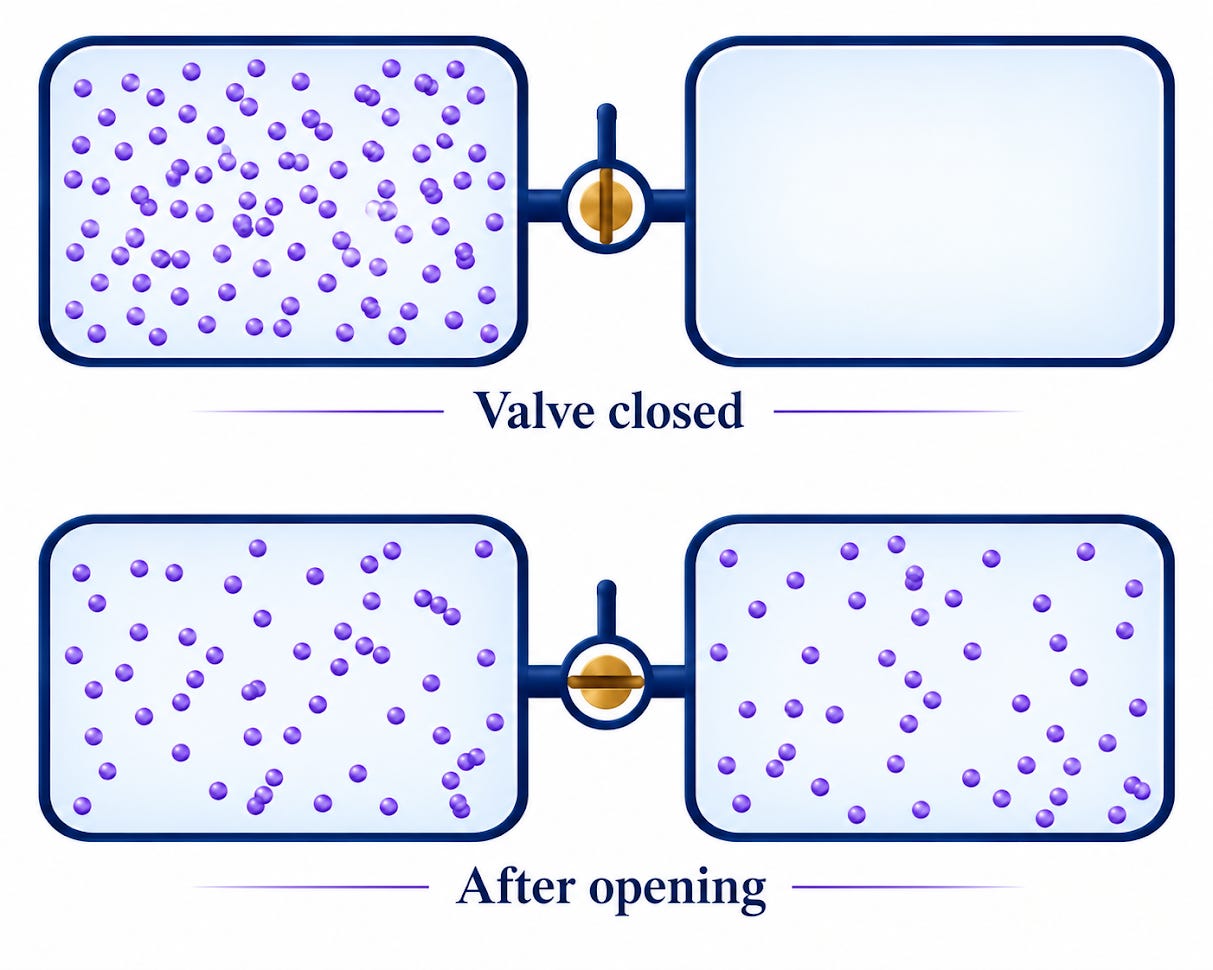
To me, the above diagram illustrates Murphy’s Law in its most fundamental form: reality continuously realizes the possibilities available to it. When the valve is closed, the particles are constrained to a single chamber, limiting the number of accessible configurations.
Opening the valve expands the information-energy landscape, allowing countless new pathways for the particles to explore. Because there are far more ways for the particles to be distributed approximately equally between the two chambers than to remain concentrated in one, the system naturally evolves toward that state. Not because it prefers balance, but because it can.
Randomness is the local exploration of possibilities, probability measures their accessibility, multiplicity counts the number of realizable configurations, and entropy reflects the increasing freedom of the system to express those possibilities. In short, the particles do not move where they “want” to go. They move where they can go. That is Murphy’s Law operating at the molecular level.
Randomness
Randomness is usually defined as unpredictability. A coin toss, the motion of gas molecules, or radioactive decay are all examples where individual outcomes cannot be predicted with certainty, even though their overall behaviour can often be described statistically.
Within my framework, randomness is not necessarily the absence of order or causation. Instead, it is the appearance of unpredictability that emerges because reality is continually exploring an immense landscape of possibilities. Reality does not make random choices.
Reality simply realizes the possibilities available to it. What appears random is often a reflection of our limited knowledge. We cannot follow every informational and energetic interaction occurring simultaneously, so the unfolding of possibility appears unpredictable.
In this sense, randomness is not chaos. It is hidden possibility. A molecule enters the left chamber because it can. Another enters the right chamber because it can. Neither outcome is preferred. Reality simply explores every available pathway.
Probability
Probability is traditionally defined as the likelihood that a particular event will occur. Within my framework, probability becomes a measure of accessible possibility. Rather than describing what reality “wants“ to happen, probability reflects how many pathways lead toward a particular outcome.
The more informational and energetic pathways that exist, the more likely that outcome becomes. Probability therefore maps possibility rather than chance. Low probability indicates relatively few accessible pathways. High probability indicates many accessible pathways.
Murphy’s Law then becomes the philosophical interpretation of probability. Outcomes with many available pathways are realized frequently. Outcomes with few pathways are realized rarely. Impossible outcomes possess no pathways at all and therefore never occur. Probability measures how open reality is to particular outcomes.
Probability Theory
Probability theory does not change mathematically within my framework. What changes is its interpretation. Instead of viewing probability theory purely as the mathematics of uncertainty, I see it as the mathematics describing how possibility unfolds.
It predicts not individual events but the long-term behaviour of countless realizations across a landscape of possibilities. In this sense, probability theory becomes the mathematics of Murphy’s Law. It quantifies how frequently reality is expected to realize particular possibilities under given conditions.
Multiplicity
Multiplicity becomes one of the most important concepts within my framework. Conventionally, multiplicity refers to the number of microscopic arrangements corresponding to the same macroscopic state. I interpret multiplicity as the richness of accessible possibility.
Every arrangement represents another pathway through which reality can express itself. The greater the number of arrangements, the greater the number of ways reality can realize that state. States with high multiplicity contain many informational configurations. States with low multiplicity contain relatively few.
Reality is not drawn toward these states by preference. It simply encounters them more often because there are more ways for them to occur. Multiplicity therefore becomes a measure of the diversity of possibility.
Entropy
Entropy is commonly introduced as a measure of disorder or, more fundamentally, as the logarithm of multiplicity. Within my framework, entropy is better understood as the realization of accessible possibility. As informational and energetic constraints loosen, more configurations become available. Reality therefore gains increasing freedom to express itself.
Entropy no longer represents increasing disorder. It represents increasing accessibility. One could describe entropy as the informational freedom available to reality under existing constraints. A low-entropy system possesses relatively few accessible possibilities. A high-entropy system possesses many.
Murphy’s Law predicts that systems spend most of their time in high-entropy states because those states possess the greatest multiplicity of realizable configurations. Entropy therefore becomes a measure of possibility rather than disorder.
A Single Principle
These concepts are often taught separately, yet within my framework they become different descriptions of the same underlying process. Randomness describes how possibilities appear individually. Probability measures how accessible those possibilities are. Multiplicity measures how many pathways exist toward each possibility. Entropy measures the overall freedom of a system to realize those possibilities.
Murphy’s Law unifies them all. Reality continually realizes whatever possibilities are accessible within its informational, energetic, and structural constraints.
Plasma Cosmology
Plasma cosmology provides a compelling illustration of this principle. Electricity has no desires. It has no intentions. It does not choose. It propagates wherever conductive pathways exist. If multiple pathways are available, electrical currents distribute themselves according to the conditions governing the system.
The same applies to plasma. Filaments form because they can. Double layers emerge because they can. Cells self-organize because they can. The universe continually explores the possibilities available to its electromagnetic structure. Murphy’s Law therefore becomes a cosmological principle.
Predictive Evolution Theory
The same principle extends naturally into biology through Predictive Evolution Theory (PET). Organisms receive information from their environments. They interpret those signals. They generate predictions. From those predictions, they produce biological variants.
Those variants are never limitless. They are constrained by the organism’s existing architecture along with its informational and energetic resources. Evolution therefore becomes the biological exploration of accessible possibility.
Species emerge because they can. Species persist because they can. Species disappear because they can no longer maintain coherence with changing environmental conditions. Life itself becomes Murphy’s Law expressed biologically.
Human Beings
Human beings are no exception. We often confuse desire with possibility. Desire asks, “What do I want?” Murphy asks, “What can happen?” Wisdom lies in recognizing the difference.
Much of human suffering arises when we continually pursue outcomes that are not genuinely accessible under present conditions. Conversely, fulfilment often emerges when our ambitions become aligned with real possibilities. Murphy’s Law therefore becomes more than an engineering observation or a statistical principle. It becomes a philosophy of living in harmony with reality itself.
The Murphy Principle
Within my information-energy substrate framework, randomness, probability, multiplicity, and entropy all describe the same universal process from different perspectives.
Randomness is the appearance of possibility unfolding. Probability measures the accessibility of those possibilities. Multiplicity measures the number of pathways leading toward them. Entropy measures the freedom available for those possibilities to become actual. Together they express what I now call The Murphy Principle:
Reality does not actualize what is desired. It actualizes what is possible. The more ways something can happen, the more frequently reality will realize it.
Final Thought
In my previous article, I argued that Murphy’s Law is better understood as a law of possibility than a law of misfortune. In this article, I’ve taken that idea further by suggesting that randomness, probability, multiplicity, and entropy are not isolated concepts, but different ways of describing how reality realizes possibility within the Information-energy Substrate.
Whether we are watching molecules spread through a chamber, plasma organize into filaments, species evolve, or human lives unfold, the same principle appears again and again. Reality does not actualize what we hope for, fear, or desire. It actualizes what is possible under the conditions that exist.
If that interpretation has any merit, then Murphy’s Law is no longer just an engineering maxim or a humorous observation. It becomes a universal principle. One that quietly links physics, biology, cosmology, philosophy, and human experience through a single, deceptively simple idea:
Anything that can happen will happen.
The challenge, then, is not to resist Murphy, but to understand him. Or perhaps, like the Taoists before us, to stop asking what reality should do and begin asking what reality can do. Because in the end, we are not separate from Murphy’s Law. We are among its countless expressions, participating in the continual realization of possibility.

References
Amalgamated Ronin. In Murphy We Trust. Substack. Available at: https://open.substack.com/pub/amalgamatedronin/p/in-murphy-we-trust?r=1ypufu&utm_campaign=post-expanded-share&utm_medium=web (Accessed: 15 July 2026).
Encyclopaedia Britannica. Entropy. Available at: https://www.britannica.com/science/entropy-physics (Accessed: 15 July 2026).
Physics Gene. The Physics of Randomness. Substack. Available at: https://physicsgene.substack.com/p/the-physics-of-randomness (Accessed: 15 July 2026).
Encyclopaedia Britannica. (n.d.). Information theory. https://www.britannica.com/science/information-theory
Encyclopaedia Britannica. (n.d.). Plasma cosmology. https://www.britannica.com/topic/plasma-cosmology
Defense Media Network. (n.d.). Murphy’s law comes from a real Murphy. https://www.defensemedianetwork.com/stories/murphys-law-comes-from-a-real-murphy/
Encyclopaedia Britannica. (n.d.). Probability theory. https://www.britannica.com/science/probability-theory
Küre Ansiklopedi. (n.d.). Murphy’s law. https://kureansiklopedi.com/tr/detay/murphys-law-fb6fe
National Geographic Society. (n.d.). Taoism. https://education.nationalgeographic.org/resource/taoism/
Plank SIP. (n.d.). The concept of God as first cause and God. https://www.planksip.org/the-concept-of-god-as-first-cause-and-god-1763655554750/
ScienceDirect. (n.d.). Murphy’s law. https://www.sciencedirect.com/topics/engineering/murphys-law
Wiley Online Library. (2017). Philosophy Compass: Taoism (Article DOI: 10.1111/phc3.12402). https://compass.onlinelibrary.wiley.com/doi/10.1111/phc3.12402
Ronin, A. (n.d.). Decoding life’s symphony: How wave... Substack. https://amalgamatedronin.substack.com/p/decoding-lifes-symphony-how-wave-e3e
Ronin, A. (n.d.). Snakes and caterpillars. Substack. https://amalgamatedronin.substack.com/p/snakes-and-caterpillars
Ronin, A. (n.d.). When fields change places. Substack. https://amalgamatedronin.substack.com/p/when-fields-change-places
Three Initiates. (1908). The Kybalion: A study of the Hermetic philosophy of ancient Egypt and Greece. Yogi Publication Society. https://archive.org/details/kybalionstudyofh00init
Ronin, A. (n.d.). Energy, information, and evolution. Substack. https://amalgamatedronin.substack.com/p/energy-information-and-evolution
Ronin, A. (n.d.). Information theory: The human mimicry. Substack. https://amalgamatedronin.substack.com/p/information-theory-the-human-mimicry
Ronin, A. (n.d.). The information-energy substrate. Substack. https://amalgamatedronin.substack.com/p/the-information-energy-substrate