
Decoding Life's Symphony: How Wave Genetics Harmonizes with PET (Pt. 2)
Revealing Predictive Evolution Theory and Wave Genetics as Two Complementary Models for Life's Electromagnetic Blueprint in a Plasma Universe

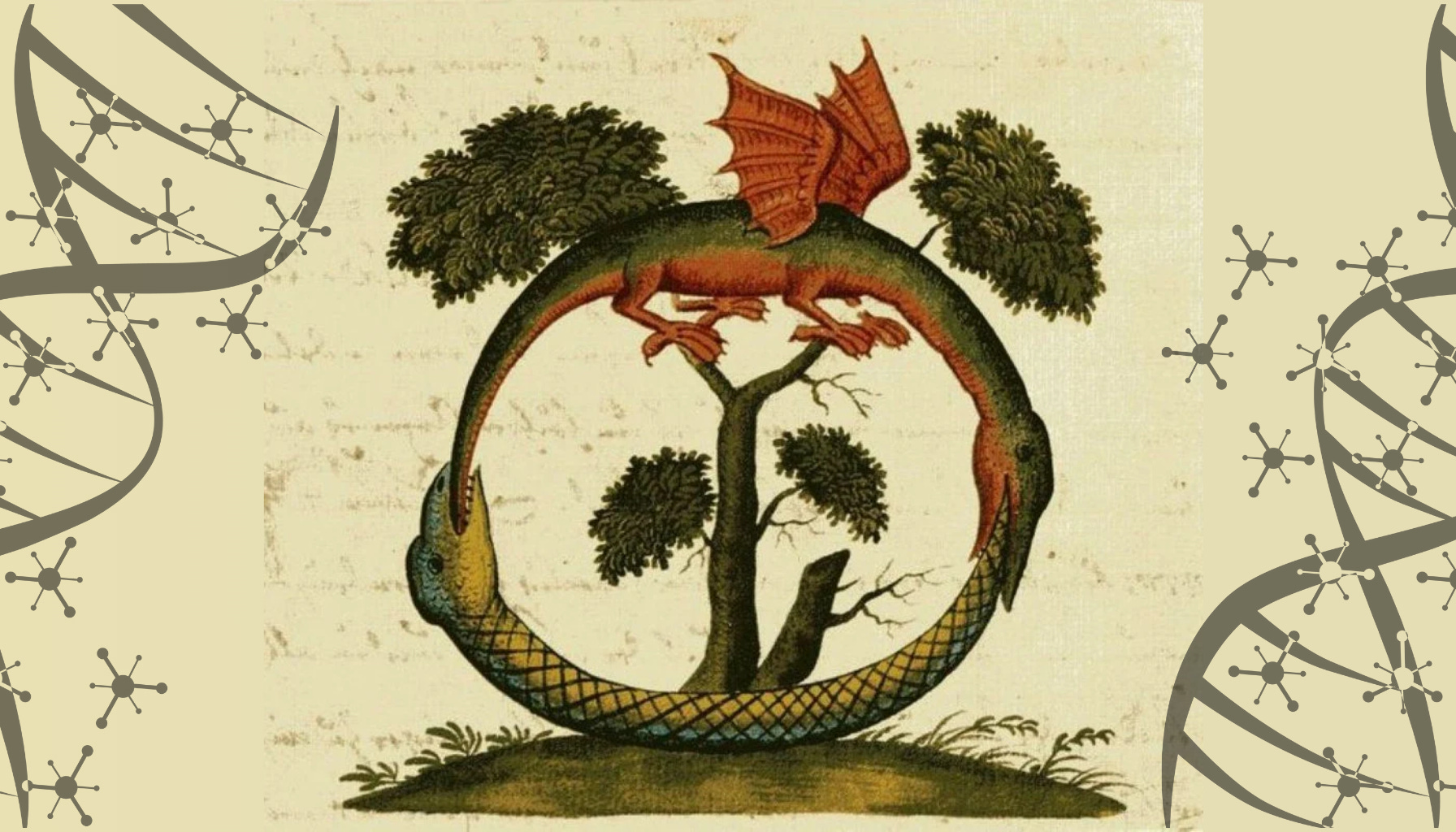
Medieval print of the Ouroboros symbol. (Image Credit: Canva)
Introduction: Beyond the Double Helix
DNA is often celebrated as the molecular blueprint of life, encoding the proteins that sustain our biological functions. But what if DNA is more than just a static repository of genetic information? What if it operates as an active participant in a dynamic, electromagnetic symphony, resonating with cosmic and environmental fields? This idea lies at the heart of wave genetics, a revolutionary hypothesis developed by Russian scientists Dr. Peter Gariaev and Dr. Vladimir Poponin. Their groundbreaking experiments suggest that DNA vibrates, resonates, and interacts with its environment in ways that extend far beyond traditional genetics.
In this blog, we will explore how wave genetics aligns with Predictive Evolution Theory (PET), a novel framework that combines insights from plasma cosmology and the Electric Universe Theory (EUT). PET posits that DNA acts as a receiver and transmitter of electromagnetic signals, predicting environmental changes and orchestrating adaptive responses. By integrating wave genetics into PET, we unlock a new paradigm that redefines life itself as an interconnected, vibrational phenomenon.
Part One of this series introduced the foundational concepts of wave genetics. Now, in Part Two, we will delve deeper into Predictive Evolution Theory to set the stage for its reconciliation with wave genetics in the subsequent parts. Before diving into PET, however, we will revisit the Electric Universe Theory and plasma cosmology to provide essential context.
Scientists Used DNA To Create World's Smallest Antenna Ever For an Unusual Reason. (Credit: Anton Petrov)
Recontextualizing Life: EUT, Fractal Universes, and Plasma Cosmology
The Hermetic principle of "As Above, So Below," famously articulated in the Emerald Tablet, offers a philosophical lens through which we can understand these interconnections. This principle posits that patterns and dynamics observed at one scale of existence are mirrored at other scales—a notion that resonates deeply with the fractal nature of the universe. From galaxies to DNA, the same recursive, self-similar patterns govern the structure and behavior of life and matter alike.
The Electric Universe: A Cosmic Web of Currents
At the heart of the Electric Universe Theory (EUT) lies the proposition that electromagnetic forces play a dominant role in shaping the cosmos. In this model, galaxies, stars, and planets are interconnected by vast filamentary structures called Birkeland currents, which transport energy and information across space. These currents, composed of plasma—the fourth state of matter—govern the formation, stability, and evolution of celestial bodies.
Unlike the gravity-centric view of mainstream cosmology, plasma cosmology emphasizes the dynamic interplay of electric and magnetic fields in organizing matter. This paradigm shift invites us to consider not only the universe’s physical structures but also the information pathways that link them, forming a vast, interconnected electromagnetic web.
The Fractal Universe and Antenna-like Dynamics
Expanding the Electric Universe framework, the concept of the fractal universe suggests that the cosmos is organized in self-similar, recursive patterns at every scale. From the spirals of galaxies to the branching of lightning and even the double helix of DNA, these fractal structures serve as conduits for energy and information. DNA, in particular, can be understood as a fractal antenna, its benzene-ring molecular structures acting as resonators that pick up electromagnetic frequencies from the environment.
A Planetary Perspective
On Earth, plasma interactions manifest in phenomena such as the auroras and the magnetosphere, which protect our planet from solar wind. These interactions are not merely physical but also informational, transmitting electromagnetic signals that influence ecosystems, weather patterns, and even biological processes.
When viewed through the lens of PET, this planetary-scale feedback system becomes a blueprint for understanding DNA’s role within its local electromagnetic environment. Just as the Earth is part of the cosmic circuit, DNA is part of the biological circuit, resonating with both terrestrial and cosmic fields.
“There are hundreds and hundreds of studies showing that our wireless wonderland of EMF is not good for our health. But you might ask: Well, HOW? When we say "EMF", we're talking about many different types of electromagnetic waves, different frequencies, different power levels, and so on. How could it possibly work? It turns out that the answer may very well be in our DNA!” Is your DNA an EMF antenna? (Credit: ScottiesTech.Info)
Predictive Evolution Theory: DNA as a Signal Processor
Defining PET
Predictive Evolution Theory (PET) challenges the Darwinian model of random mutations and natural selection by proposing that life evolves through an active, predictive mechanism embedded within DNA. According to PET, DNA is not merely a static code but a dynamic antenna, capable of receiving, processing, and transmitting electromagnetic signals. These signals include environmental cues, bioelectric patterns, and cosmic influences, all of which inform DNA’s adaptive responses.
PET suggests that organisms do not passively wait for mutations to occur; instead, they generate multiple genetic variants in response to electromagnetic information. These variants are essentially predictive experiments, with the most successful adaptations thriving while others are phased out. This model accounts for rapid evolutionary changes and the emergence of traits that seem too precise to arise by chance.
DNA, Benzene Structures, and Electromagnetic Fields
DNA’s predictive capability arises from its interaction with electromagnetic fields, and its benzene-ring molecular structure plays a pivotal role in this process. Friedrich August Kekulé famously described the benzene molecule’s structure as a snake devouring its tail—an image that echoes the Ouroboros symbol, representing cycles and feedback loops. Within the framework of PET, this metaphor underscores DNA’s dual role as both a receiver and transmitter of information, perpetually cycling environmental signals into adaptive responses.
These benzene structures act as fractal antennas, resonating with electromagnetic fields across scales. Just as the Ouroboros symbolizes an eternal cycle, DNA’s benzene rings ensure a continuous flow of information between the organism and its environment.
A Symphony of Feedback Loops
PET envisions life as a series of nested feedback loops, with DNA at the center. At the cellular level, DNA resonates with bioelectric fields generated by surrounding tissues. At the organismal level, it interacts with environmental biofields, such as forests or oceans. And at the planetary level, it aligns with larger electromagnetic systems like the Schumann resonance or geomagnetic activity. These feedback loops ensure that DNA is constantly tuned to its environment, enabling real-time adaptation.
If my content sparks your curiosity and keeps your neurons firing, consider giving it a little extra charge with a donation. Your support powers the current of inspiration!
“As we will reiterate in this video, the cosmos we inhabit is filled with electromagnetic principals at all scales of life. We all know what DNA is, right? Well, you’d be surprised. Not only do chromosomes conduct electrons to various effects, they also exist at a layer of reality which our brain is not capable of imagining." DNA in the Electric Universe | Electricity of Life. (Credit: The Thunderbolts Project)
Bridging PET and Wave Genetics
Revisiting Wave Genetics
Wave genetics provides a complementary perspective to PET by emphasizing DNA’s vibrational properties. Gariaev and Poponin’s experiments revealed that DNA emits and absorbs electromagnetic waves, creating harmonic patterns akin to music. This discovery aligns with PET’s assertion that DNA is an electromagnetic signal processor, capable of interpreting and responding to its environment.
The Phantom DNA Effect
One of wave genetics’ most intriguing findings is the phantom DNA effect, where DNA leaves an energetic imprint in its surroundings. PET interprets this phenomenon as evidence of DNA’s role in transmitting information into the environment. This imprint is not a passive residue but an active signal that contributes to the organism’s adaptive feedback loop.
Resonance as Adaptation
Wave genetics also highlights the importance of resonance in DNA’s adaptive processes. Just as DNA produces unique harmonic patterns, it also resonates with external frequencies to "tune" its genetic expressions. In PET, this resonance is the mechanism by which DNA generates adaptive variants, ensuring that life remains in harmony with its environment.
Toward Reconciliation
As we prepare to explore the reconciliation of wave genetics and PET in Part Three, it becomes clear that these frameworks are not competing theories but complementary models. Wave genetics provides the vibrational context, while PET offers the predictive mechanism. Together, they redefine DNA as both a blueprint and a dynamic participant in life’s electromagnetic symphony.
References:
Gariaev, P., & Poponin, V. (1995). "The DNA Phantom Effect." Institute of Quantum Genetics.
Saitta, E. T., Balaji, L., Mitchell, J. S., & Makovicky, P. J. (2023). "Feather Evolution Following Flight Loss in Crown Group Birds." Science Advances.
Tennant, J. (2010). Healing is Voltage: The Handbook.
Peratt, A. L. (2015). "Physics of the Plasma Universe." Springer Science & Business Media.
Alfven, H. (1986). "Double Layers in Astrophysics." IEEE Transactions on Plasma Science.
Shaner, S., et al. (2023). "Bioelectronic Microfluidic Wound Healing: Direct Current Stimulation of Injured Cell Collectives." PubMed.
Chalmers University of Technology. (2025). "How Electricity Can Heal Wounds Three Times Faster." Chalmers News.
Bohm, D. (1980). Wholeness and the Implicate Order. Routledge.
Sahtouris, E. (2000). Earthdance: Living Systems in Evolution.
Tesla, N. (1926). "The Transmission of Electrical Energy Without Wires." Scientific American.
