
Stretching the Surface: Plate Tectonics VS The Expanding Earth Theory
A Paradigm Shift in Earth Science: Exploring the Role of Electromagnetic Forces in Planetary Expansion, Plate Dynamics, and the Evolution of Organisms

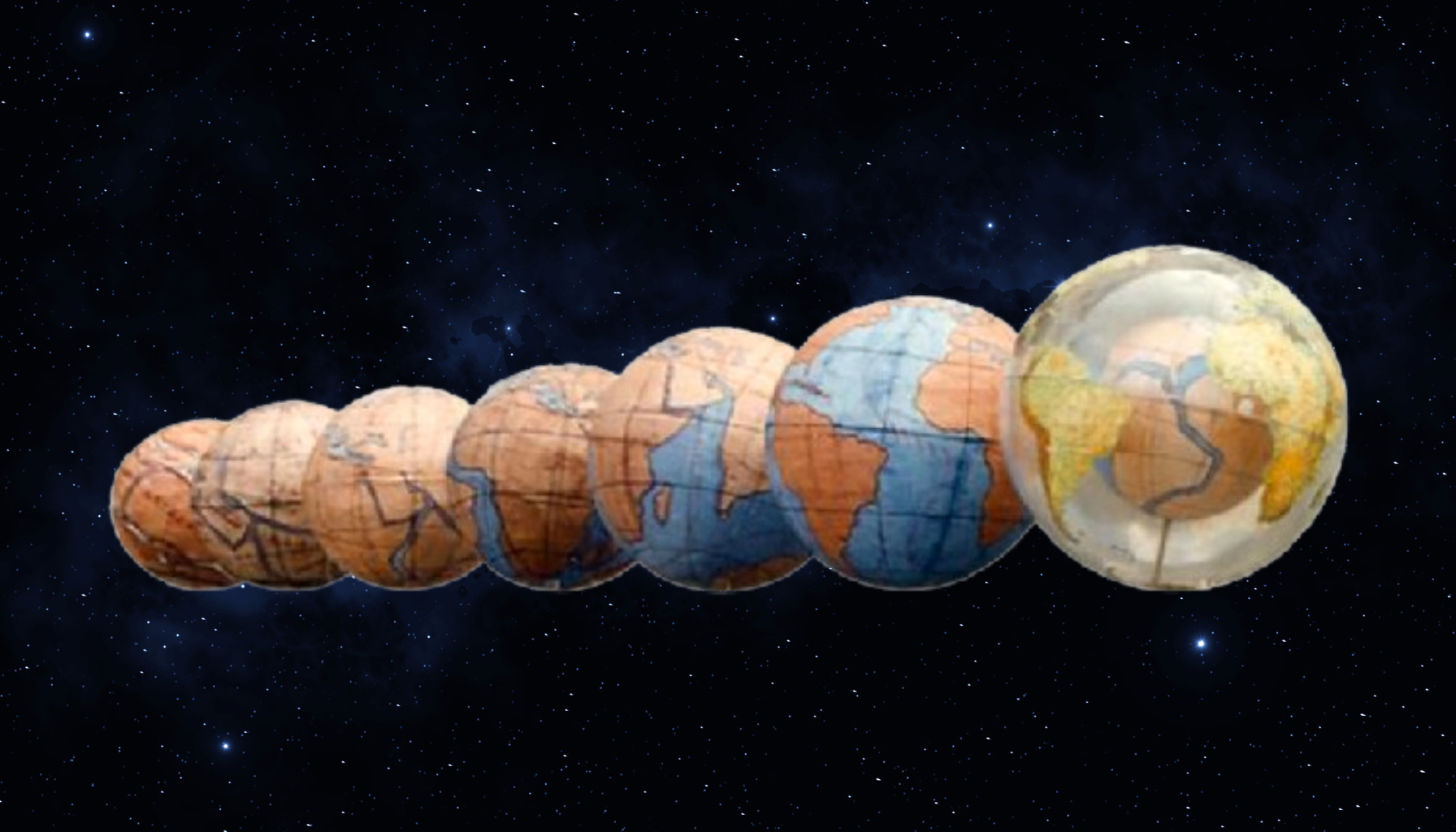
The Earth-Expansion Model Part A -- The Death of Plate Tectonics. (Credit: David Noel)
Introduction: A False Dilemma and a New Perspective
The debate between Plate Tectonics and the Expanding Earth theory has often been framed as a binary choice: either the Earth's crust is shifting over a fixed-size globe, or the planet itself is gradually increasing in size. What if, however, this dichotomy is a false dilemma? What if both phenomena are facets of a deeper, interconnected process shaped by electromagnetic forces on a planetary scale? Enter the Electric Universe theory, rooted in plasma cosmology, which posits that the universe operates as a vast electromagnetic feedback system. Applying this framework to Earth science reveals compelling possibilities for reconciling these seemingly contradictory theories.
Part 1: Understanding Expanding Earth and Plate Tectonics
The Expanding Earth Theory
The Expanding Earth theory proposes that Earth has grown in size over geological time, driven by processes occurring within its interior. Proponents suggest that in the distant past, continents were tightly packed on a much smaller globe, with no vast oceans separating them. As Earth expanded, the crust fractured and stretched, giving rise to oceans and the arrangement of continents we see today.
Evidence often cited includes:
The apparent fit of continents, particularly across the Atlantic.
Fossil distributions suggesting land connectivity in ancient times.
Geological features, such as mid-ocean ridges, that imply continuous creation of new crust.
Critics argue the lack of a clear mechanism for planetary expansion. However, the theory provides an intriguing lens for reinterpreting paleontological and geophysical data.
Plate Tectonic Theory in Summary
Conventional Plate Tectonics theory explains Earth’s dynamics through the movement of rigid crustal plates over a semi-fluid mantle layer. Key processes include:
Subduction: One plate diving beneath another.
Seafloor Spreading: Magma rising at mid-ocean ridges, creating new crust.
Collision and Uplift: Plates converging to form mountain ranges.
While Plate Tectonics is widely accepted, it does not entirely account for phenomena such as uniform crustal expansion or the global distribution of certain ancient fossils.
The Role of Pangea
The concept of Pangea, a supercontinent that existed around 335 to 175 million years ago, provides a critical link between Plate Tectonics and Expanding Earth theories. Pangea’s breakup is traditionally explained by plate movements over a fixed-sized Earth. However, proponents of the Expanding Earth theory argue that the supercontinent's formation and subsequent fragmentation fit more naturally with a smaller Earth expanding over time. This expansion would stretch and separate landmasses, giving rise to today’s continents and oceans. Pangea thus becomes a central piece in understanding Earth's dynamic history, bridging these two frameworks.
The Origin of the Expanding Earth. (Credit: See The Pattern)
Support my work and help fuel more exciting discoveries by donating—every contribution makes a difference!
Part 2: A Solar System Experiment in Expansion
The Inner Solar System’s Pressure Dynamics
Imagine Earth as a bead in a complex system of stratified solar system pressures. Planets closer to the Sun are denser and smaller due to higher solar and electromagnetic pressures. If Earth, through gravitational or electromagnetic forces, were pushed outward in its orbit, it would enter a region of lower solar pressure. This would:
Reduce external constraints on Earth’s interior, allowing it to expand.
Stretch the crust, creating fissures and new landforms.
Gradually reduce overall planetary density.
Conversely, a new planet introduced into the inner solar system, such as a hypothesized Venus insertion, would cause gravitational and electromagnetic disturbances, forcing neighboring planets to adjust their orbits and potentially triggering rapid expansion events.
Gravity, Atmosphere, and Organism Size
As Earth expands, its surface area grows, thinning the atmosphere as it spreads over a larger volume. Simultaneously, reduced gravitational pull from a less dense planet could allow organisms to grow larger, as seen in fossil records of megafauna and flora. Over time, this combination leads to:
Smaller organisms due to increased gravity from a denser atmosphere stabilizing after expansion.
A thinner atmosphere influencing the planet’s ability to sustain large-bodied creatures.
Instead of viewing atmospheric density as the sole driver of organism size, this model suggests a common root cause: Earth’s gradual expansion.
Does the Inner Solar System Show Clear Signs of Expansion? (Credit: See The Pattern)
Part 3: Reconciling Plate Tectonics with Expanding Earth
Electromagnetic Forces and Planetary Dynamics
In the Electric Universe framework, electromagnetic forces are key drivers of planetary processes. Earth’s core and mantle are electrically conductive, interacting with solar currents and galactic Birkeland currents. These interactions can:
Induce plasma oscillations, generating heat and material expansion within Earth’s interior.
Create periodic surges that weaken the lithosphere, decoupling it from the mantle and allowing plates to shift.
Modulate mantle convection patterns, reconciling expansion with localized tectonic activity.
Cymatics and Plate Movement
Cymatics, the study of wave patterns on surfaces, offers a powerful analogy for tectonic activity. Electromagnetic waves passing through Earth could organize matter into predictable patterns, influencing:
Plate boundaries and their movements.
The formation of mid-ocean ridges and subduction zones.
Cyclical shifts in tectonic processes tied to solar activity.
This perspective aligns with the idea that Plate Tectonics and Expanding Earth are complementary rather than contradictory. Plates shift as Earth expands, and electromagnetic coupling provides the energy and framework for both phenomena.
Conclusion: Toward a Unified Earth Science Paradigm
The time has come to bridge the divide between Plate Tectonics and Expanding Earth theories. By incorporating the Electric Universe framework, we unlock new explanations for Earth’s dynamic behavior, from planetary expansion to plate motion. This model not only reconciles old debates but also offers a paradigm shift, emphasizing the interconnectedness of Earth and its cosmic environment.
Enthusiastically, we suggest this perspective challenges traditional Earth science and invites exploration into the electromagnetic forces shaping not just our planet, but the universe itself. The reconciliation of these theories is not just a scientific curiosity; it’s a call to rethink how we understand the evolving Earth and its place in the cosmos.

References:
Carey, S. W. (1976). The Expanding Earth. Elsevier.
Wegener, A. (1912). The Origin of Continents and Oceans.
Peratt, A. L. (2015). Physics of the Plasma Universe. Springer.
Anderson, D. L. (1989). Theory of the Earth. Blackwell Scientific.
"Electric Universe." Thunderbolts Project.
"Large Low-Shear-Velocity Provinces." Sci.News.
Elkins-Tanton, L. T. (2012). "Core-Mantle Interactions and Planetary Evolution." Annual Review of Earth and Planetary Sciences.
Cymatics and Patterns in Nature.