
Predictive Evolution: The Future of Life on Earth
How the Information of the Cosmos Shapes Life's Unseen Adaptations

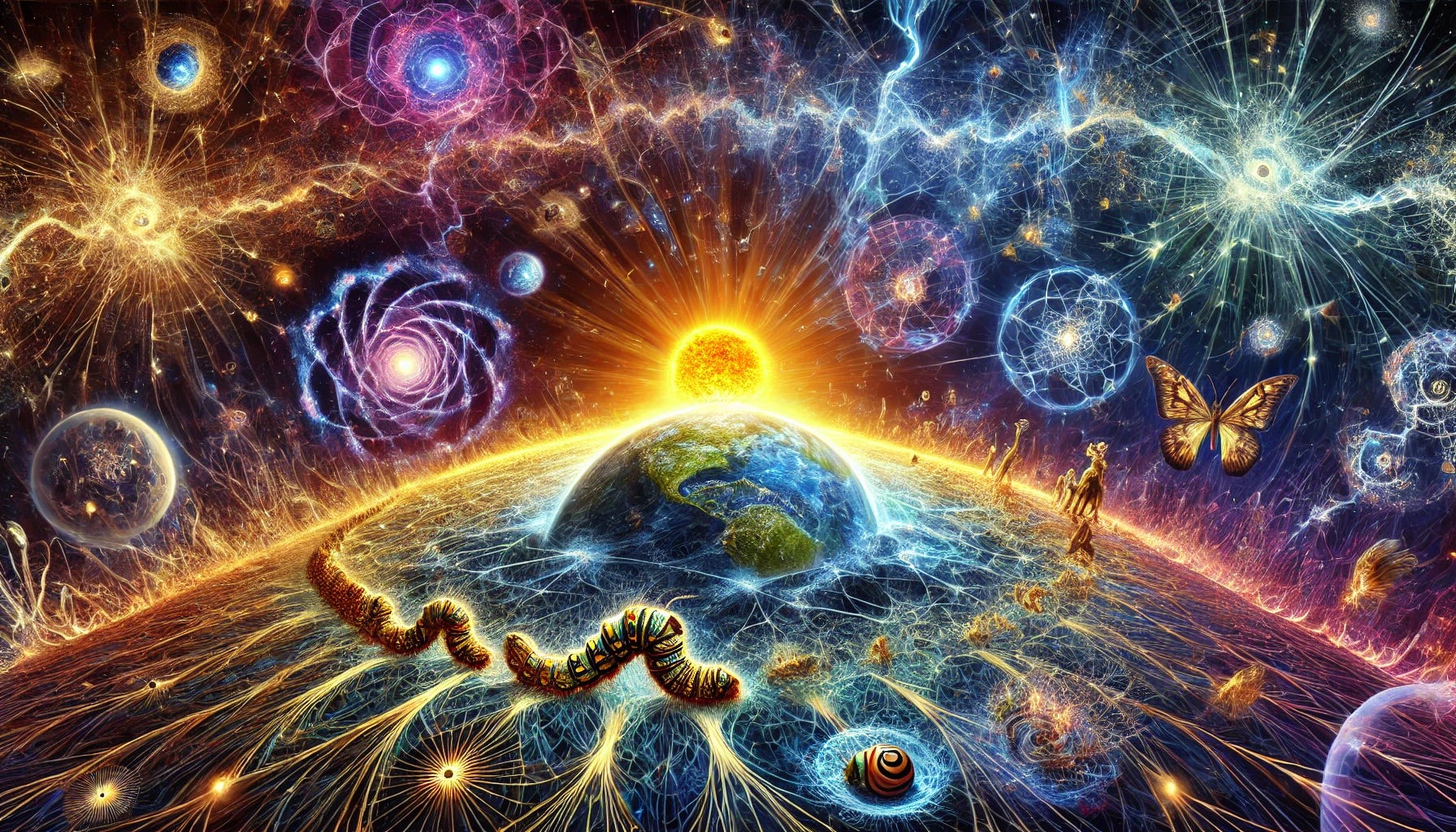
This image was conceptualized and generated with the assistance of AI.
Breaking Free From the False Dichotomy
The debate between Darwinian evolution and Creationism has been a long-standing ideological battle, with each side standing firm in its respective beliefs. But what if the truth lies somewhere beyond these polarized arguments? Let’s be blunt. Both theories fall short of explaining how life actually adapts to environmental changes. This is where Predictive Evolution Theory (PE) steps in to offer a more holistic and elegant solution. I’m going to offer you a fresh perspective. One that doesn’t require you to choose between “random mutations” and “divine intervention.”
PE reconciles Darwinian evolution’s “survival of the fittest” with the notion of a non-personified creator. Not some magical being that controls the fate of all life. It also plugs the gaps in current evolutionary theory and shows how the electric universe’s information reservoirs actively shape life. And yes, this means we’re all operating in an electric, connected, information-rich ecosystem that’s far more complex and intertwined than the old scientific dogma or religious myths have ever suggested.
Cosmic Reservoirs of Information
Let’s get something straight. Life is electric. From the electricity flowing through your neurons to the bioelectric signals used by every living organism. We are all just electrical beings riding along on this electric planet in an electric solar system. I’m talking about the electric universe theory. This theory postulates that the universe itself is not only energetic. It is deeply embedded with information. Communicated and transmitted through electromagnetic fields.
These fields aren’t some abstract concept. They are real. They surround us. And they shape everything in existence. We exist within a sea of electromagnetic energy. And guess what? The Sun, our very own star, plays a vital role. It’s the powerhouse that sends out a continuous stream of electromagnetic information and energy. Traveling through the heliosphere. This is the Sun’s vast influence zone that extends far beyond the planets. It is a cosmic "cloud" of information that we all draw from.
Now, if we zoom in on Earth, we notice something incredible. Not only is our planet's environment constantly changing due to solar activity, orbital shifts, and other factors. Life is also responding to these changes in real-time. The electromagnetic fields of the planet and the solar system (even so far out as the Milky Way Galaxy) and the collective and individual biofields of species serve as the information reservoirs from which organisms use to predict and adapt to environmental changes.
So here's the thing. The process of evolution isn't limited to just reactive changes. It is proactive. There is an anticipatory strategy built into the biology of life itself. The electromagnetic fields are an active communication network that informs all living organisms about potential future changes. It provides them with the information (and energy) needed to produce adaptations instantly.
This is where PE offers a far more robust understanding of evolution than Darwin’s "slow and gradual" mutations ever could.
What’s Wrong with Darwin and Creationism?
Darwinian evolution, as grand as it may seem, has one massive flaw. It doesn’t explain how species can adapt so quickly to environmental changes. The theory of gradual mutation doesn’t adequately account for sudden, drastic shifts. Such as those seen in the aftermath of catastrophic events such as the Younger Dryas Event (YDE). When rapid speciation exploded in response to sudden climatic changes.
PE theory, on the other hand, explains how multiple variants of species are produced in a single generation. Responding to predictive signals in the electromagnetic fields that allow them to anticipate and preemptively adapt to changes.
As for Creationism, let’s not get bogged down by the notion of a divine hand micromanaging evolution. PE offers a more nuanced understanding. The "creator" is not a personified god. It is the informational and energetic forces of the universe itself. These forces exist, influence life, and shape it through the planet's electromagnetic fields. The "creator" isn’t a separate entity pulling strings. It is an impersonal, omnipresent informational system that gives rise to life’s infinite variety.
A More Complete Explanation of Adaptation
So how does PE theory work? Simply put, life is constantly producing variants in response to predictive signals from the environment. These variants are predictions of what’s to come. The idea is that the biosphere doesn’t just adapt to changes once they happen. It prepares for future shifts before they even occur. Each generation of organisms produces a range of possible adaptations that are in direct response to predictions of future environmental changes.
In one generation, there might be a spectrum of variants. With some more suited to a potential environmental change and others less so.
But how do these adaptations happen? It’s not as simple as “mutations” or “random genetic drift” as Darwin suggested. The information that drives these adaptations comes from the electromagnetic and bioelectric fields that surround and permeate all living things. Every species and individual organism, whether they are aware of it or not, is tapping into this vast information reservoir to predict the changes it might face. This allows them to adapt, not over generations, but within a single generation. They produce the necessary variants to thrive in a shifting environment.
Caterpillars, for example, may develop strategies like disguising themselves as fecal matter because their bioelectric field has tapped into the informational fields predicting the presence of predators. This adaptation would not be gradual. It would happen in response to an immediate need. Within the context of a single generation of caterpillars. Variants of caterpillars would be produced that look like poop. And these would either succeed or fail based on the predicted environmental change.
Species are not only gathering information about environmental changes to make predictions. They are also accessing (albeit unconsciously) the vast reservoir of information stored in the electromagnetic fields of the planet. For instance, where did a caterpillar acquire the information and blueprints necessary to disguise itself as a snake? There is no direct evolutionary connection between a caterpillar and a snake, nor could this intricate adaptation have emerged purely from the caterpillar’s internal genetic library. Instead, information about the snake (its role in the food chain, its predators, and even its physical appearance) is embedded in the planet's electromagnetic "data cloud."
The caterpillar, through mechanisms intrinsic to life, downloads this data to produce a variant with the necessary disguise in a single generation. This demonstrates a twofold strategy.
Organisms access data about environmental changes.
Organisms download specific design data to execute transformations.
Life is thus programmed to utilize this natural information system. It refines itself continuously in response to a perpetually shifting environment. This also creates a positive feedback loop of information between life’s variants and the information complex. Every new adaptation of a species, whether it creates new variants or not, is fed back into the information reservoirs as new data.
In other words, evolution itself is evolving.
It is not a stretch of the imagination to suggest that humans have access to this information, too. However, not only through the aforementioned mechanism programmed into life itself. Human consciousness can access this planetary “data cloud” and download information and upload information.
As arguably the most creative species, humans are feeding even more complex information into the electromagnetic fields. Every thought, vision, or dream we have is information processed from the “data cloud” and fed back into it as new information.
For each generation that passes, more information is available. And therefore, more complex systems will be created. In the form of complex living organisms. Or complex human concepts manifesting in science and technology, art and literature, and social governance. Everything returns to and updates the “source”.
The YDE’s Rapid Speciation in Action
The Younger Dryas Event (YDE) is a perfect example of how Predictive Evolution works in the face of a sudden and extreme environmental shift. In this period, around 12,000 years ago, Earth experienced a dramatic geophysical event. According to PET, species would have predicted the shifts and responded by rapidly producing a variety of variants. With some species surviving by predicting the harsh changes that were coming. While others couldn’t adapt fast enough and went extinct.
PET explains that, rather than slow, gradual mutations over millions of years, the YDE triggered a burst of species adapting instantly in response to the energetic and electromagnetic changes brought on by this catastrophic event.
Predictive Evolution at Play
Human beings, unlike most species, possess an extraordinary ability to access and interpret these informational fields in ways that others cannot. This is where our creativity and imagination come in. Dreams, epiphanies, revelations, and prophecies are all ways our minds process the electromagnetic and bioelectric information available to us. Through these cognitive processes, we predict societal and environmental changes and create the necessary solutions to survive and thrive.
But even on a smaller scale, look at human siblings. Children born to the same parents often have radically different personalities and talents. Why? Because, much like in the rest of nature, each sibling is born as a variant produced by their genetic and environmental information. Each of them is predicting different potential future environmental scenarios. The different ways they process and respond to information from the electromagnetic fields around them create the diversity of human traits we see. Some of which are more successful in certain environments than others.
Letting Humans and Species Adapt
When humans face unsuccessful variants, like certain siblings or offspring, the best approach isn’t to force them into a one-size-fits-all societal mold. No, the solution is simple. Find the environment they are best adapted to and let them thrive there. The same goes for all species. Stop forcing organisms to survive in environments they were never meant for. This is where PE offers practical, real-world solutions.
Predictive Evolution Theory offers a fresh, more accurate understanding of how life adapts, predicts, and thrives in an ever-changing universe. By acknowledging the role of electromagnetic fields and bioelectric information systems, PE bridges the gaps left by Darwinian evolution and Creationism. It offers a somewhat unified theory of how life evolves, predicts, and adapts.
It’s time we stop constraining ourselves with outdated rules and theories. And start embracing the future of evolution. The evolution of evolution, in more ways than one. A future that is active, predictive, informed, and electric.