
Energy, Information, and Evolution
Integrating Richard H.W. Funk’s Feedback Models with PET’s Predictive Adaptation Framework



Unlocking the Secrets of Evolution Through Energy, Information, and Feedback
What if evolution wasn’t just a story of survival, but one of connection? A connection between energy, information, and life itself? Richard H.W. Funk’s study, “Understanding the Feedback Loops between Energy, Matter, and Life,” explores how life shapes and is shaped by the energy and matter around it. Forming a complex web of feedback loops that drive evolutionary and ecological change.
Enter Predictive Evolution Theory (PET), a revolutionary framework that takes these feedback loops to the next level by introducing the role of electromagnetic biofields as dynamic information systems. PET bridges the gap between energy-matter interactions and genetic adaptation. Offering a bold new lens for understanding life’s predictive capabilities.
From the Electric Universe’s vast electromagnetic currents to the fractal self-organization of vortex theory and the vibrational magic of Cymatics, this conversation weaves together cutting-edge ideas to illuminate the hidden connections that guide evolution. By blending Funk’s groundbreaking insights with PET’s predictive mechanisms, we unveil a model where DNA acts as an antenna. Decoding cosmic and environmental signals to anticipate change.
This isn’t just evolution. It is evolution with foresight. Powered by the universe’s electric heartbeat. Ready to explore how life and the cosmos are fundamentally intertwined? Let’s go!
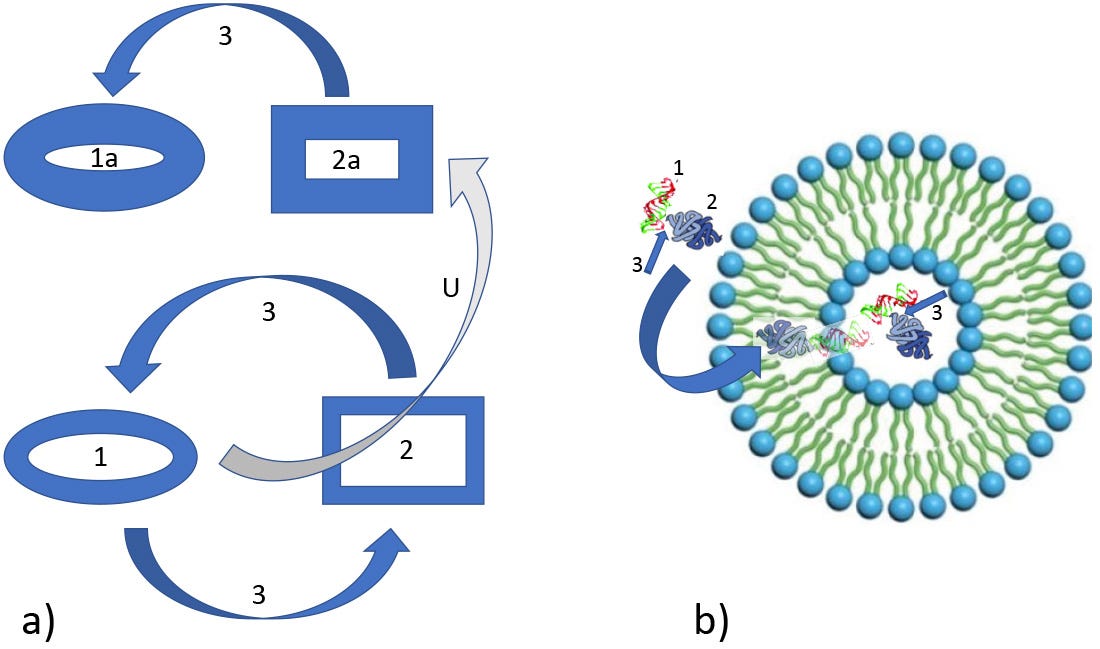
“Feedback loops between information and matter during evolution. (a) Relation between information (1) and matter (2) and feedback loops (3) as mediating process. This principle can be favored by environmental cues (like in Benard reaction) or by intrinsic molecular properties (BZ reaction) or in combination. U: upgraded information consolidating the state of matter as well of the related information signature. (b) Relation between information (1) and matter (2) and feedback loops (3) in protocells. Left: information within matter (1, e.g., nucleic acid) and matter as tool (2 translating protein) is incorporated (bow arrow) into a sheltering phospholipid vesicle. 3: process of information/matter feedback, e.g., for replication.” Understanding the Feedback Loops between Energy, Matter and Life. (Credit: Richard H.W. Funk)
Evolution Reimagined: A Dynamic Electric Framework
Richard H.W. Funk's study highlights the intricate feedback loops between energy, matter, and life, emphasizing that evolution is a dynamic interplay of interconnected systems. Building on this, Predictive Evolution Theory (PET) proposes that organisms not only react to environmental changes. They anticipate them using electromagnetic biofields.
They encode predictive information for preemptive adaptation.
This idea aligns with the Electric Universe Theory (EUT), which asserts that electromagnetic forces drive cosmic and biological processes alike. Thus, making life and the cosmos part of a vast electric circuit.
Frequency Wave Theory (FWT) further supports this by suggesting that everything is governed by resonance and vibrational patterns. With DNA acting as a receiver and transmitter of these signals. Processing environmental and cosmic information.
Through Denis Pelletier’s Dual Supersession Theory, evolution is seen as a layered process where older systems persist and provide stability while new adaptations emerge, creating a spiral of innovation and complexity. Together, these concepts redefine evolution as a predictive, electromagnetic phenomenon woven through the fabric of the universe, where life adapts and thrives by tuning into the frequencies of its environment.
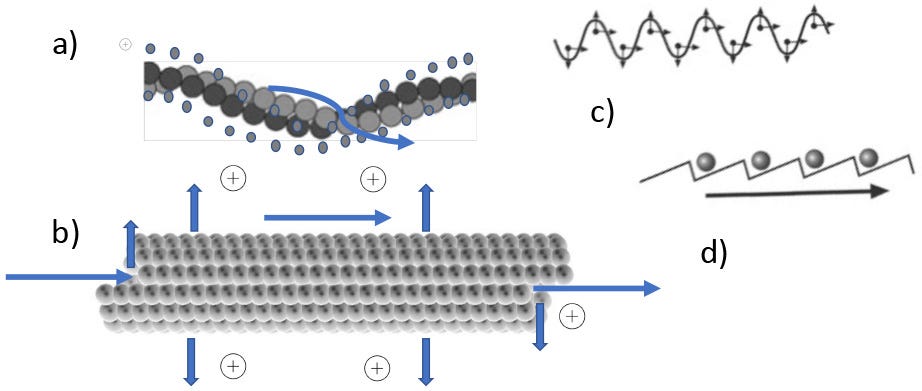
“Electric and topographical properties of cytoskeletal elements. (a) Actin filament with electropositive counterions. Cations are in a loosely bound state and can be moved by EMF (winding arrow). (b) Similar situation in the hollow (water filled) microtubules: Arrows depict in - out- and longitudinal movement. (c) Propagating EMF wave. (d) Attraction and rectifying of ionic movement (arrow) along a filament, induced by outside EMF due to molecular ratchets.” Understanding the Feedback Loops between Energy, Matter and Life. (Credit: Richard H.W. Funk)
Unlocking Life’s Secrets: Energy, Matter, and the Quantum Web of Feedback Loops
Richard H.W. Funk’s groundbreaking review, Understanding the Feedback Loops between Energy, Matter, and Life, offers a fascinating glimpse into the unseen forces shaping biological complexity. Published in Frontiers in Bioscience-Elite, the article explores how life thrives at the intersection of energy, matter, and information, challenging conventional ideas and opening doors to revolutionary perspectives on evolution and physiology.
Funk argues that feedback loops are far more than regulatory mechanisms. They are the architects of complexity. Orchestrating the exchange of matter and information across every level of life. Central to his thesis is the role of electromagnetic fields, which serve as mediators of long-range communication within and between cells. Funk’s exploration also ventures into the “quantum” realm, where phenomena like electron tunneling and molecular coherence redefine how we understand biological efficiency and precision.
By examining resonance (where vibrations and waves synchronize to amplify interactions), Funk highlights a hidden layer of cellular organization. These resonances might act as nature’s messaging system. Processing information and enabling adaptability at astonishing scales.
Funk’s work pushes the boundaries of biology. He proposes that life isn’t just a collection of chemical reactions or genetic codes but a symphony of electromagnetic and quantum interactions. This visionary framework invites us to rethink the principles that govern evolution, self-organization, and even consciousness itself.
In essence, Funk reminds us that life is a dynamic masterpiece of energy, matter, and information. It is woven together by the intricate web of feedback loops that sustain and evolve it.
Bridging Feedback Loops: Funk’s Study Meets Predictive Evolution Theory
Richard H.W. Funk’s exploration of feedback loops between energy, matter, and life forms a compelling foundation for understanding evolution and ecological dynamics. PET, with its focus on electromagnetic biofields and predictive adaptation, offers a fresh perspective that both aligns with and challenges Funk’s approach.
Shared Insights:
Feedback Loops: Both Funk and PET highlight the dynamic exchange between organisms and their environments. Funk frames these loops as mutual interactions of energy, matter, and life. While PET emphasizes the role of electromagnetic signals in guiding DNA-level adaptations.
The Role of Energy: Funk views energy as the driver of life systems. From cellular processes to ecosystems. PET extends this by identifying electromagnetic fields as the medium through which energy also carries predictive information for adaptation.
Information as a Driver: Both frameworks see information as central to evolution. Funk likely considers information as emergent. While PET elevates pre-existing biofields and environmental signals as reservoirs of encoded data.
Key Differences:
Mechanisms of Interaction: Funk leans on biochemical and thermodynamic models. PET introduces electromagnetic resonance as a direct mechanism for adaptation. Bypassing some traditional pathways.
Scale of Focus: Funk emphasizes macroscopic changes over millennia. Whereas PET spans scales. From DNA’s immediate responses to large-scale environmental patterns. Prioritizing predictive over reactive processes.
Information Reservoirs: Funk may see information as a product of system interactions. PET posits structured, pre-existing reservoirs within biofields. Thus, offering organisms a library of potential adaptations.
By integrating PET with Funk’s study, we uncover a multi-dimensional framework for evolution. One in which life isn’t just reacting to its environment. It is anticipating changes through electromagnetic signals. This fusion transforms feedback loops into a predictive, information-rich process, bridging traditional models with the dynamic, electric fabric of life.
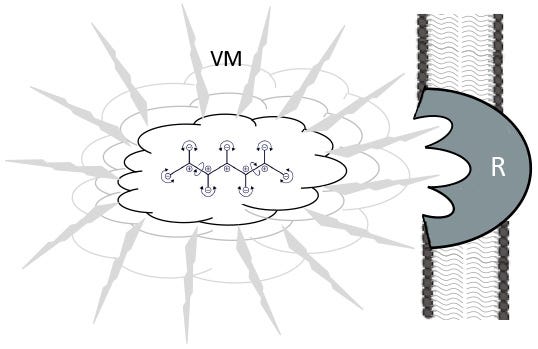
“Vibration effects of molecules in a ligand-receptor situation. Jittering and vibrating molecule (VM) by Brownian movement, surrounded by polarized water molecules. These are also propagating the IR - waves for resonant recognition (Cosic) of a membrane bound receptor (R), prior to the “classical” key and lock binding.” Understanding the Feedback Loops between Energy, Matter and Life. (Credit: Richard H.W. Funk)
Harmonic Synergy: Merging Funk’s Feedback Loops with Frequency Wave Theory in PET
Richard H.W. Funk’s “Understanding the Feedback Loops between Energy, Matter, and Life” provides an insightful framework for exploring the interconnectedness of life, energy, and matter. Now, let’s crank up the resonance by integrating FWT from PET into the mix! This approach reveals a universe where frequencies and resonance are the hidden architects behind the feedback loops Funk so expertly describes.
Frequencies as the Pulse of Evolution
Wave-Driven Energy Transfers: Think of energy as riding on waves (electromagnetic) flowing through ecosystems and structuring interactions. PET takes this a step further by showing how frequency patterns guide where and how energy moves.
Resonance and Harmony: Organisms aren’t just reacting. They are syncing up with specific frequencies. Whether it’s a Schumann resonance or geomagnetic pulse, resonance enhances feedback stability. They align biological systems with their environments.
Information Embedded in Waves: Forget static signals. Frequency patterns encode the instructions for life itself! DNA acts as nature’s antenna, decoding these waves and transforming them into responses. From behavioural shifts to genetic adaptations.
Reimagining Funk’s Feedback Loops
Frequency as the Driver:
Funk describes energy flows shaping life’s processes. FWT refines this by showing that frequencies are the steering wheel. It ensures energy flows are purposeful and information-rich.Example: Shifts in solar frequencies ripple through an ecosystem’s biofield, influencing everything from plant growth to animal migration.
Resonance Stabilizes Feedback Loops:
While Funk highlights balance in energy-matter exchanges, FWT shows resonance as the stabilizer. When life and environment are “in tune,” feedback loops hum along harmoniously.Example: Stable ecosystems exhibit harmonic frequency alignment. Disrupted systems? Chaotic, mismatched frequencies.
Waves as the Language of Information:
Funk emphasizes information as emerging from interactions. FWT flips the script. Information already exists. Encoded in frequency waves. Ready for DNA to interpret and act on.Example: Predator-prey dynamics aren’t just reactive. Frequency shifts in predator activity ripple through biofields, prompting prey to adapt proactively.
Predictive Adaptation Through Frequency Coupling:
Funk’s evolution model shows life adapting over time. PET’s FWT unlocks real-time, predictive changes. Organisms tune into environmental frequency shifts. Using them as “pre-signals” for future adaptation.Example: Increased geomagnetic activity triggers migratory birds to recalibrate their navigation systems. An anticipatory response to frequency shifts.
Building Bridges: Integrating Funk and FWT
Shared Ground:
Both frameworks recognize the interplay between energy, matter, and life as a dynamic feedback system.
Funk’s emergent information aligns with FWT’s encoded frequency patterns, showing a continuum from interaction to structured resonance.
Where They Differ:
Funk focuses on biochemical and physical processes. FWT zooms out to the waveforms orchestrating these phenomena.
Funk frames adaptation as a time-driven process. FWT introduces instantaneous resonance-based changes.
A Unified Vision
By weaving FWT into Funk’s study, we get a richer understanding of life’s feedback loops. Frequencies act as both the messengers and the medium. They enable energy and information to flow seamlessly. This fusion not only expands our grasp of evolutionary processes but also highlights the alternation of resonance that connects energy, matter, and life across all scales.
It’s evolution. But on a cosmic wavelength!
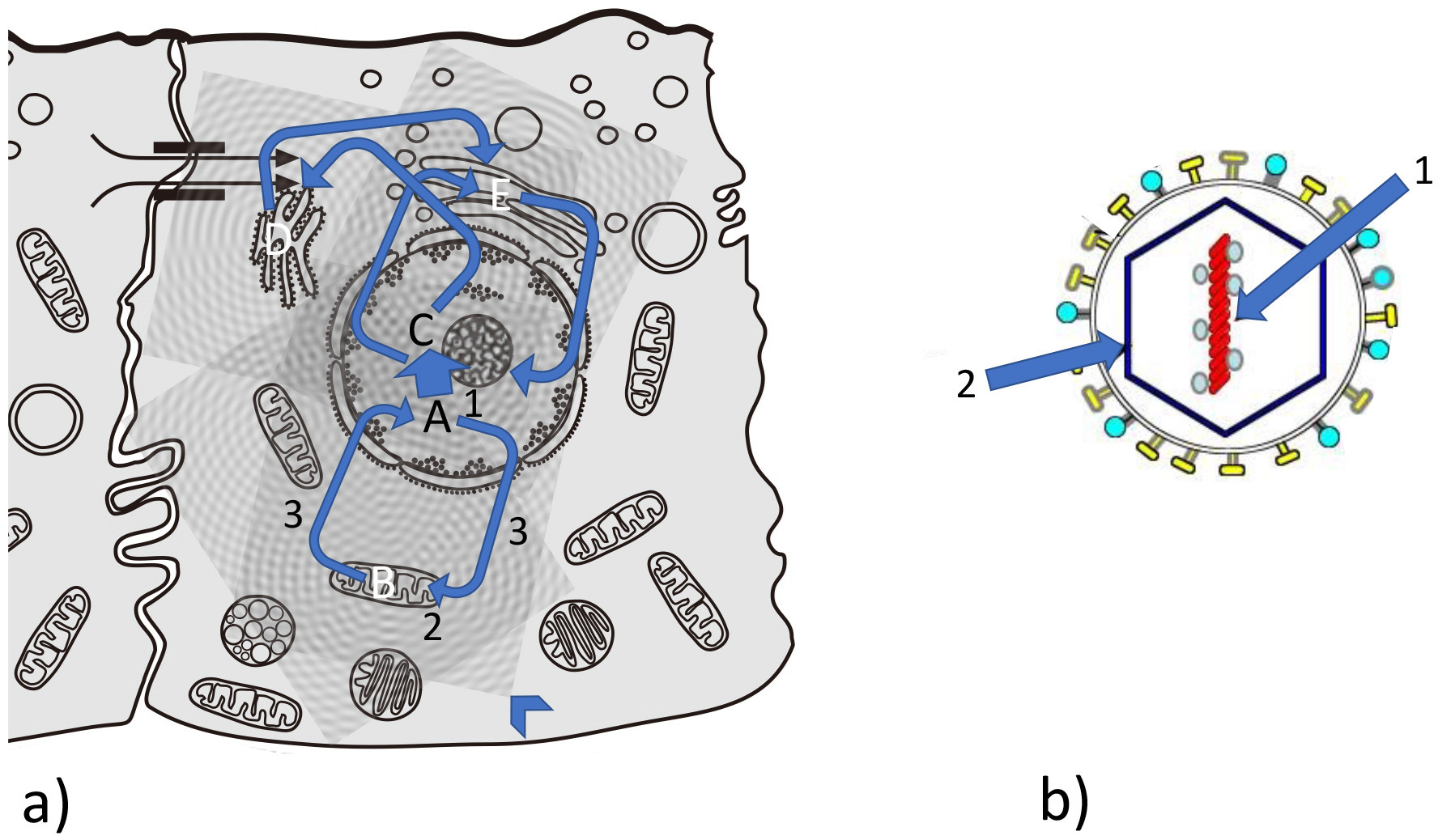
“Feedback loops between information and matter during evolution. (a) Complex interrelation between information/matter feedback loops in a eukaryotic cell. Example for information matter loops: A from nucleus to mitochondrion (B); C from nucleus to endoplasmic reticulum (ER) (D); from ER to Golgi apparatus (E) and from and to nucleus. Arrowhead: interference pattern of vibrational patterns coming from organelles and biomolecules (see Fig. 7). (b) Quasi-crystalline situation in a typical virus: information (1) (conserved in nucleic acid) and matter and structure (2) (capsid as well as phospholipid membrane and spikes) is without a self-mediated process (no 3).” Understanding the Feedback Loops between Energy, Matter and Life. (Credit: Richard H.W. Funk)
Decoding Life’s Blueprint: Connecting Funk’s Feedback Loops with Information Theory in PET
Richard H.W. Funk’s exploration of energy, matter, and life’s feedback loops provides an intriguing foundation for understanding how ecosystems operate. But what if we could zoom in deeper (beyond the visible exchanges of energy and matter) and discover a hidden layer of information shaping it all? That’s where Information Theory in Predictive Evolution Theory (PET) steps in. They turn the biological script into a predictive, data-driven masterpiece.
Information: The Cosmic Connector
Funk’s Insight: Life’s processes emerge as energy and matter interact. With information as a byproduct of these exchanges.
Example: Nutrient cycles influence ecosystem dynamics.
PET’s Expansion: Information isn’t an afterthought; it’s intrinsic to life’s blueprint. Encoded in electromagnetic biofields, this data guides DNA responses and preps organisms for potential outcomes stored in environmental and cosmic fields.
Example: Funk sees nutrient cycles as feedback loops. PET adds that the biofield of an ecosystem “writes and reads” these cycles. Transmitting data to organisms about competition, nutrient distribution, and survival strategies.
Feedback Loops as Nature’s Information Systems
Funk’s Feedback Loops: Energy and matter sustain life through dynamic exchanges. With information shaping behaviours and stability.
PET’s Take: Feedback loops are high-tech information circuits! Electromagnetic fields carry encoded data. Decoded by DNA for predictive adaptation. Organisms aren’t just reacting. They are reading signals in the “aether”.
Example: A plant facing nutrient scarcity doesn’t merely adapt post-crisis. PET suggests its DNA interprets biofield signals about upcoming shortages. Thus, prompting a variety of preemptive growth shifts or biochemical tweaks.
3. Scaling Information from Micro to Macro
Funk’s Focus: Energy-matter interactions influence life across scales. From cells to ecosystems.
PET’s Enhancement: Feedback loops operate in hierarchical layers:
Microscale: DNA acts as a receiver of biofield data, tweaking gene expression.
Macroscale: Entire ecosystems function as biofield broadcasters, encoding collective environmental information.
Example: An ecosystem’s biofield holds “layers” of data. From immediate predator-prey dynamics to long-term climate trends. They guide individual and collective species behaviour.
Predictive Adaptation: Funk’s Feedback Loops Meet PET’s Crystal Ball
Funk’s Evolutionary Model: Species evolve reactively. Shaped by present and past energy-matter interactions.
PET’s Predictive Evolution: Organisms anticipate the future by decoding biofield signals that reflect environmental and cosmic changes. Adaptation isn’t just reactive. It is proactive and multivariable.
Example: In a desertifying ecosystem, Funk might explain how species evolve to tolerate reduced water. PET adds that electromagnetic signals, like changes in the Global Electric Circuit (GEC), alert organisms to impending arid conditions. Thus, triggering preemptive shifts in genetics or behaviour.
A Unified Vision: Where Funk Meets PET
Funk’s feedback loops brilliantly illuminate the dynamic dance of energy, matter, and life. PET’s Information Theory cranks up the complexity. It shows how information is encoded, processed, and transmitted across scales to create a predictive, interconnected biosphere.
Together, they reveal life as not just reactive. It is forward-thinking. Powered by data streams flowing invisibly through the cosmos.
The result? A universe alive with possibility. Where the secrets of evolution are written in waves. Decoded by DNA. And shaped by the pulse of the environment. It's a thrilling glimpse into nature’s ultimate information system!
The Feedback Revolution: Dual Supersession Meets Predictive Evolution
Imagine a world where life doesn’t just react to change. It anticipates it. By blending Dual Supersession Theory (DST) with PET, we unlock a revolutionary view of evolution that goes far beyond Richard H.W. Funk’s feedback loops of energy, matter, and life.
This expanded framework alternates between external signals from cosmic and environmental electromagnetic fields (EMFs) and internal decoding systems within organisms. Thus, revealing how life evolves with foresight.
External Signals: Tuning Into the Cosmic Symphony
Life is immersed in a universe brimming with information. From the Sun’s energetic flares to the subtle shifts in Earth’s geomagnetic field. These external EMFs carry critical data about the environment and the cosmos. Organisms, through their biofields, act as receivers, tuning into these signals:
Cosmic Guidance: Solar activity and geomagnetic shifts act as a planetary information stream. This enables species to predict long-term trends like migration pathways or climate changes.
Environmental Clues: Local biofields from forests, oceans, or deserts encode signals about resources, predators, and ecosystems. This helps organisms adapt preemptively.
This external information is nature’s predictive blueprint. It offers a head start on evolutionary shifts.
Internal Decoding: Biofields and DNA at Work
Receiving signals is only half the story. Life’s magic happens when these signals are decoded and transmitted within organisms.
Biofields as Processors: Each organism’s biofield acts as an electromagnetic interface. It captures external signals and transforms them into actionable biological data.
DNA as the Antenna: Far from being static, DNA resonates with these signals. It triggers genetic or epigenetic changes that prepare organisms for shifts before they occur.
Human Electrome: In complex systems like humans, the electromagnetic fields of the heart and brain (the "human electrome") further amplify and interpret external and internal signals. Thus, creating an advanced feedback system.
This seamless internal communication elevates simple reactions into predictive adaptations.
Dual Supersession: The Future of Evolution
By alternating between external cosmic guidance and internal biofield intelligence, DST and PET reveal a multi-layered feedback system where evolution is no longer blind. It is a coordinated, anticipatory process:
External to Internal: Organisms decode external signals to predict and prepare for environmental changes.
Internal to External: Adaptations at the genetic and behavioural levels feed back into the ecosystem. Influencing the biofields of entire species and environments.
For example, as a forest experiences drought, electromagnetic shifts signal plants to preemptively adjust their genetics for water retention. These changes ripple outward, harmonizing the ecosystem as animals and plants adapt together.
A Cosmic Symphony of Feedback Loops
With DST and PET, evolution is reimagined as a conversation between the cosmos and life itself. Organisms don’t just adapt to what is. They adapt to what will be. Guided by an intricate exchange of external and internal information. It’s a revolution in feedback loops, where energy, matter, and life align through predictive foresight. Ccreating a universe where every change carries the promise of innovation.
Thornhill's POV: The Simple Electric Universe. (Credit: The Thunderbolts Project)
The Electric Universe: Life’s Evolution in an Electrified Cosmos
The Electric Universe theory posits that electromagnetic forces, not just gravity, play a fundamental role in structuring the cosmos. In this paradigm, stars, planets, and galaxies are interconnected by vast electric currents. Such as Birkeland currents. They form a cosmic web of energy and matter.
Life in an Electric Universe evolves within these electromagnetic environments. Shaped by the currents and fields that envelop planets. These fields influence genetic adaptation, cellular communication, and even consciousness. Thus, making life an intrinsic participant in the electromagnetic dance of the universe.
Vortex Theory and DNA: The Self-Organizing Antenna
Vortex theory describes how energy and matter self-organize into coherent structures through spiraling motions. Visible from galactic formations to atomic particles. This principle connects to the double helix structure of DNA, a natural antenna designed to receive and transmit electromagnetic signals.
The helical form is not merely a genetic code carrier. It is also a resonator for environmental and cosmic information. It tunes into biofields and broader electromagnetic frequencies to guide adaptation and evolution.
Birkeland Currents: Fractals of the Cosmic Electric Circuit
Birkeland currents are scalable electric structures that transport charged particles across vast distances. They form the universe's electrical scaffolding. These currents exhibit fractal patterns. From the galactic scale down to the planetary and even biological levels.
By connecting celestial bodies, they enable a flow of energy and information that maintains cosmic stability and supports life’s dynamic processes. As fractal systems, they echo the self-similar patterns of growth and structure observed in nature. From lightning strikes to neural networks.
Cymatics: Shaping the Universe with Frequency and Form
Cymatics demonstrates how electromagnetic frequency waves shape matter into intricate patterns. They reveal the profound impact of vibration on physical structure. In the Electric Universe, these patterns act as templates for creating and organizing everything from galaxies to cellular systems.
Cymatic formations are designed to process and transmit signals in fractal information feedback loops. This makes them scalable features of the universe. These feedback loops, shaped by electromagnetic resonance, underline the universe’s capacity for self-organization, adaptation, and evolution.
Evolution Reimagined: Feedback, Prediction, and the Cosmic Pulse
As we bring this exploration to a close, it becomes strikingly evident that evolution is more than mere reaction. It is an alternation of energy and information to produce foresight. Richard H.W. Funk’s groundbreaking study of feedback loops between energy, matter, and life provides a robust foundation for understanding the interwoven processes that drive ecological and evolutionary change.
Building on this, PET offers an electrifying expansion. It presents a universe alive with electromagnetic signals and biofields that shape life’s trajectory in predictive and adaptive ways.
In our journey, we’ve illuminated the mysteries of the Electric Universe, where Birkeland currents and fractals demonstrate the scalable architecture of existence. We’ve touched on vortex theory’s self-organizing genius and its connection to DNA’s double-helix structure. Functioning as an antenna for cosmic signals. Cymatics, as a visual manifestation of frequency waves, underscores how these energetic patterns shape structures, creating a feedback loop of information processing and transformation at every scale.
Together, these ideas craft a compelling vision of evolution as a predictive, fractal system. Informed by cosmic signals and sustained through dynamic feedback loops.
Merging Funk’s Feedback Loops with PET’s Predictive Paradigm
The synergy between Funk’s exploration of energy-matter-life feedback loops and PET’s information-centric framework reshapes our understanding of evolution. Funk’s focus on energy as a driver of life aligns seamlessly with PET’s assertion that electromagnetic fields serve as conduits of pre-encoded, predictive information.
By integrating these perspectives, evolution emerges as a process not just of adaptation but of anticipation. Where organisms resonate with and respond to the electric pulse of their environment.
Key Insights and Innovations
Energy and Electromagnetic Fields: Funk emphasizes energy flows as central to sustaining life. While PET extends this to propose that electromagnetic fields encode and transmit critical information that guides adaptive changes.
Feedback Loops as Predictive Systems: Funk views feedback loops as stabilizers of ecosystems. While PET reframes them as circuits of dynamic information exchange. They empower organisms to adapt preemptively to environmental changes.
From Emergent to Intrinsic Information: Funk considers information as emerging from energy-matter interactions. Whereas PET positions it as a foundational, pre-existing reservoir. This paradigm shift suggests evolution operates within a structured library of possibilities encoded in biofields.
A Unified Model of Evolution
This integration outlines a cohesive framework:
Energy flows act as carriers of encoded information.
Electromagnetic biofields transmit signals across scales. They influence DNA and ecosystems alike.
Life functions as both processor and contributor. Decoding signals for predictive adaptation while maintaining systemic balance.
Feedback loops are resonant systems. Calibrated by frequencies that guide stability, adaptation, and realignment.
For example, in a forest ecosystem, increased solar activity may alter the electromagnetic biofield. Thus, prompting preemptive adjustments:
Trees regulate photosynthetic activity.
Animals modify migration or feeding behaviours.
The ecosystem realigns collectively. Guided by the encoded biofield signals.
A Future Powered by Resonance
By embedding Funk’s energy-centric framework within PET’s predictive model, we unlock a revolutionary understanding of evolution. Information, not just energy or matter, takes center stage as the key driver of adaptation and resilience. Life becomes an active participant in a cosmic resonance. It decodes signals, adapts to changes, and contributes to the universe’s dynamic balance.
This is evolution reimagined. A process where anticipation meets action. Guided by the universal language of energy, frequencies, and encoded possibilities.
References:
Funk, R. H. W. (2022). Understanding the Feedback Loops between Energy, Matter, and Life. Frontiers in Bioscience-Elite, 14(4), 29. Retrieved from https://www.imrpress.com/journal/FBE/14/4/10.31083/j.fbe1404029/htm
Al-Khalili, J., & McFadden, J. (2014). Life on the Edge: The Coming of Age of Quantum Biology. New York, NY: Crown Publishing.
Talbott, W. (2018). The Electric Universe. Thunderbolts Project. Retrieved from
https://www.thunderbolts.info
Burylko, O., & Mikhailov, A. (2012). Fractal Properties of DNA Sequences and the Role of Electromagnetic Fields. Bioelectromagnetics, 33(3), 171-181.
Alfven, H. (1981). Cosmic Plasma. Dordrecht: Reidel Publishing Company.
Sheldrake, R. (2009). Morphic Resonance and the Memory of Nature. Rochester, VT: Inner Traditions.
Simons, A. M. (2011). Modes of Evolutionary Anticipation: Reactive vs. Predictive Adaptation. Trends in Ecology & Evolution, 26(11), 537-544.
Knapton, H. (2010). Cymatics: A Visual Exploration of Sound’s Role in Shaping Matter. Journal of Acoustic Studies, 45(2), 87-94.
Scott, D. E. (2015). The Interconnected Cosmos: Plasma Physics in the Universe. Big Bear Lake, CA: Mikamar Publishing.
Shapiro, J. A. (2011). Evolution: A View from the 21st Century. Upper Saddle River, NJ: FT Press.