
eMission Impossible
From Carbon Myths to Cosmic Mechanisms, the Breakdown of Electromagnetic Coherence is Reshaping Earth’s Systems and Exposing Both the Flaws and the Fraud in the AGW Narrative

A Crumbling Narrative?
Something is shifting. Not just in the weather, but in the story we’re told about it. For decades, the Anthropogenic Global Warming (AGW) narrative has ruled as dogma. It has been anchored in unvalidated computer models, cherry-picked data, and a near-religious belief that CO₂ is the planetary thermostat. But that certainty is cracking. A growing number of researchers are producing work that’s demonstrable, replicable, and transparent. Work that refuses to hide behind statistical smoke and mirrors.
The cracks in the façade are not just scientific. They are cultural. Remember Greta Thunberg? Once the global face of climate alarm, skipping school to lecture world leaders about the planet’s imminent collapse. Now she sails boats to raise awareness for isolated humanitarian causes. Noble, yes. But they’re a long way from “the world will end in twelve years.” That pivot says something profound. The panic is fading. Or was never really there. The performance is wearing thin because the panic was in the performance.
Even billionaire philanthropists are walking it back. Bill Gates, who was once a fierce promoter of the carbon panic, with objectives such as capturing carbon from the atmosphere. He now admits that cold kills ten times more people than heat, that Net Zero is inefficient, and that humanity will adapt and thrive. Those statements don’t come from fringe blogs. They come from the very architects of the climate narrative itself. When its own champions start to hedge, the writing is on the wall. The well is drying up.
The problem runs deeper than climate science. Cosmology suffers from the same disease. An overreliance on abstract or mathematical models and a refusal to see the universe as it truly behaves. Electrically! Both climatology and cosmology have reached a crisis point. Each field denies the same thing. The role of plasma, electromagnetism, and the Sun as the driving forces behind planetary change. And since we all live on a changing planet, that’s a pretty severe case of negligence or incompetence. Or malice?
Through the lens of plasma cosmology and using the framework of the electric universe theory, the pattern comes into focus. What we are witnessing is not an isolated or man-made climate phenomenon. It is a system-wide breakdown in electromagnetic coherence. Earth is not malfunctioning. It is responding to the same solar and cosmic conditions affecting the rest of the solar system. The Sun is changing, and so, everything tethered to its electromagnetic field is changing with it in this inescapable phase shift.
The magnetosphere is weakening and shifting.
The atmosphere is destabilizing (what we call “climate change”).
The hydrosphere shows signs of stratification and current disruption.
The geosphere is responding through earthquakes and volcanic upticks.
The biosphere, life itself, is displaying magnetoreceptive confusion and extinction events.
And here lies the deeper, more uncomfortable thought. This misunderstanding may not be accidental at all. For the last century, at the very least, Academia has become increasingly gatekept, guided, and in many ways, captured. If we follow the monetary breadcrumbs, it’s not hard to see why the Sun must remain taboo for the general public. Every major global narrative, from climate change to economic crashes, and from anomalous seismicity to pandemics, points blame everywhere but the Sun.
Why? Because if we acknowledge solar causation, it would expose the predictable and cyclic nature of the solar-induced geomagnetic catastrophes that have reshaped Earth again and again throughout history, let alone the multidecadal and multicentennial cycles used to predict and take advantage of market slumps and increases in illnesses. Those ancient records of celestial calendars exist, guarded and encoded by priestly elites (the Magi of old) who understood the heavens better than our modelers do today.
In this light, Ad Huijser’s 2025 paper, “Global Warming and the ‘Impossible’ Radiation Imbalance,” lands like a spark in dry grass. It is meticulously reasoned and is a data-driven challenge to the AGW orthodoxy. The paper clearly shows that solar dynamics and natural variability, not CO₂, dominate the planet’s heat balance. In a world where the climate story has become a convenient cover-up or distraction, Huijser’s work is a reminder that the real driver of change has been that big, bright thing in the sky all along.
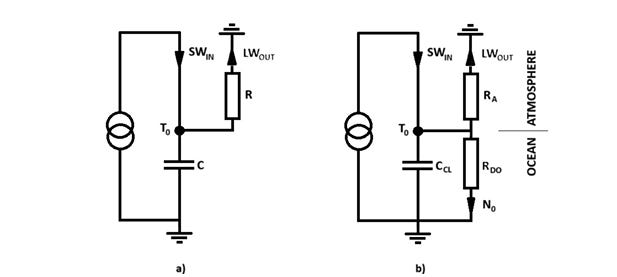
“Fig.2. Schematic thermal circuit for our Earth’ climate system, for illustration purposes only: a) In its most rudimentary form consisting of a heat capacitor C shunted by a resistor R coupled to a source with constant flux SWIN. b) As a more realistic circuit where the heat capacity of our climate CCL is separated from the rest of the Earth’ (almost infinite) heat capacity and where a small part N0 of the incoming flux is “leaking” from the climate system through the resistor RDO to the deep ocean layers. RDO is much larger than the resistance of the atmosphere RA as N0 is less than 0.6% of SWIN (see Section 2.3).” Global Warming and the “impossible” Radiation Imbalance. (Credit: Ad Huijser)
Physically Impossible?
A recent paper titled “Global Warming and the ‘Impossible’ Radiation Imbalance,” by physicist Ad Huijser, takes a direct swing at the heart of the Anthropogenic Global Warming (AGW) theory. Published in Science of Climate Change (Vol. 5.3, 2025, pp. 81–106), it’s a 26-page peer-reviewed study filled with figures, equations, and data. Yet written with the kind of precision that invites readers to question the “CO₂ did it” narrative.
Huijser, who has a background in thermal systems and energy balance modeling, argues that Earth’s growing radiative imbalance (the net energy flux into the climate system) cannot be explained by greenhouse gases alone. Using the IPCC’s own numbers, he shows that attributing the most recent warming to CO₂ is physically impossible.
Instead, he finds that natural variations in incoming shortwave solar radiation (SW_IN), driven by shifts in cloud cover and albedo, account for roughly two-thirds of the warming since the mid-1970s. That means climate sensitivity (the warming per unit of forcing) is far lower than IPCC models suggest, and natural variability plays the dominant role.
Huijser frames Earth’s climate as a thermal system responding to radiative perturbations at the top of the atmosphere (TOA). In AGW logic, rising greenhouse gases should explain the entire observed imbalance. But satellite data doesn’t cooperate. The imbalance is growing faster than GHG forcing alone can justify. To make sense of this, Huijser treats the climate as a subsystem within a larger Earth Thermal System (ETS) and introduces the concept of a “virtual balance” to separate natural and human contributions.
By comparing:
CERES satellite data (TOA radiation, since 2000)
ARGO ocean heat content (OHC, since 2004)
Huijser finds that natural increases in SW_IN explain most of the observed trends. Greenhouse effects account for roughly one-third at best. Feedback arguments, like GHGs causing cloud changes, don’t close the gap.
The result? Climate sensitivity is far lower than mainstream models predict. This challenges AGW’s monopoly on the explanation. Huijser starts by taking aim at a 2024 KNMI visualization (based on Hansen et al., 2023) that showed “accelerating” warming via a growing TOA imbalance. This is often called “warming in the pipeline.”
He calls it misleading. Short-term trends, he says, can’t be trusted when the climate’s relaxation time (the time it takes to rebalance) is only about 3–5 years. Global Climate Models (GCMs), by assuming decades-long relaxation times, artificially inflate climate sensitivities.
In Huijser’s analogy, Earth behaves like a pot of water. It absorbs about 160 W/m² of solar energy and balances it through outgoing longwave radiation (LW_OUT). Complexity arises not from magic CO₂ feedback loops. Complexity arises from simple redistribution. Winds move 80% of the heat, and ocean currents handle the rest.
The rise in ocean heat content (around 10²² joules per year, equivalent to less than 1 W/m²) is tiny compared to total energy flows. And since greenhouse gases mainly influence the upper 50–100 meters of ocean water, they’re more about slowing cooling than storing new heat.
This sets the stage for Huijser’s central claim. The observed imbalance and OHC trends are natural. They are not greenhouse-driven. Huijser models the climate using an RC-circuit analogy, where heat capacity (C) stores energy and resistance (R) governs energy loss. The feedback parameter (λ) ties these together and represents how efficiently the system sheds excess heat.
Key ideas and data sources:
Virtual Balance Approach: separates shallow-climate dynamics from deep-system flux (N₀) into the deep ocean or space.
CERES-EBAF v4.2 (2000–present): tracks shortwave and longwave fluxes.
ARGO OHC data (0–2000 m, 2004–present): converts ocean heat into fluxes.
Temperature datasets: HadCRUTv5 (surface), UAH-TLT, and ARGO SST.
GHG forcing: CO₂-equivalent trends around 0.019–0.037 W/m² per year.
A few simplified takeaways from the math:
The climate relaxes to equilibrium exponentially, with a time constant τ ≈ 4 years.
Observed imbalance N(t) decays back to zero unless new forcing is added.
By separating N(t) − N₀(t), Huijser isolates the true climate forcing from the deeper Earth system.
Shortwave forcing from clouds and albedo changes (~0.041 W/m²/year) emerges as the major driver.
Here’s where it gets interesting!
Huijser finds that the observed increase in energy imbalance (about +0.049 W/m² per year) is much higher than what greenhouse forcing can produce (0.019–0.037 W/m² per year).
Since the mid-1970s, shortwave forcing (SW_IN) has flipped from negative to strongly positive.
Cloud cover changes explain most of it: about +0.065 W/m²/year of the increase.
When the numbers are run through his model:
Roughly two-thirds of recent warming stems from natural shortwave increases.
Only one-third comes from greenhouse gases.
Ocean heat content confirms it. About 20% of total heat is stored in the upper 100 meters, with the rest sinking into deeper layers (N₀ ≈ 0.75 W/m²). Cloud-related feedbacks add only around 0.006 W/m²/year. Barely 15% of what’s observed. In plain English: The Sun, clouds, and albedo shifts explain far more than CO₂ ever could.
For AGW to hold, you’d need to twist the math. Boosting feedback unrealistically or cutting observed temperature trends in half. Both lead to absurd outcomes like “>100% anthropogenic warming,” which breaks physical logic unless we assume some kind of invisible cooling that doesn’t exist. Huijser emphasizes that shortwave increases are primary drivers, and not the feedback effects. The big feedbacks (water vapor, lapse rate, etc.) are already baked into λ (the system’s natural resistance).
Historical jumps in ocean heat content, such as those in the 1970s, happened before greenhouse forcing really ramped up. That timing alone points toward natural triggers. Especially cloud variability and solar modulation. The popular claim of “warming in the pipeline” collapses once you factor in how solar input and OHC actually behave together. Huijser’s analysis leads to one unavoidable conclusion: A greenhouse-gas-only model doesn’t work.
Natural shortwave forcings, roughly 0.035–0.040 W/m² per year, not only match but often exceed greenhouse forcing. These solar-linked factors explain about two-thirds of all observed warming. The correlation between imbalance growth and SW_IN, not CO₂, is striking. If there’s any acceleration happening, it’s driven by the Sun and clouds. It is not driven by emissions.
In short, Earth’s energy budget looks more like a dynamic solar-atmospheric system than a trapped-heat greenhouse. That means it’s time to re-evaluate our models, policies, and assumptions about what’s really driving the planet’s climate engine.
Huijser’s paper uses the same CERES and ARGO satellite datasets that mainstream climate science relies on, but he reads them very differently. While the IPCC’s AR6 report attributes more than 100% of post-1950 warming to greenhouse gases (implying natural factors have a net zero or negative influence), Huijser finds the opposite. Natural shortwave variability explains most of it.
That reversal hasn’t gone unnoticed. Predictably, some mainstream voices have dismissed the paper outright. The journal, Science of Climate Change, insists on peer review, though it’s known for publishing alternative and non-consensus perspectives.
On the other side, independent researchers and skeptical communities have been quick to engage. Sites like Watts Up With That highlight the study’s straightforward physics and accessibility. On X, especially in European discussions, the paper is already being shared as evidence that the “CO₂ myth” is losing ground.
As of October 29, 2025, there are no formal rebuttals from mainstream journals, but scrutiny is expected. Especially over assumptions like the fixed climate heat capacity (C_CL) and how shortwave forcing is attributed.
Whatever one’s stance, Huijser’s approach is transparent. He lays out every equation, every dataset, and every step of the reasoning. That openness makes his work replicable, which is exactly what science needs if it’s ever going to move beyond entrenched dogma and back toward discovery.
Return to the Sun

Abstract: This review examines the study "Natural Rhythms of Climate Variability and Anthropopressure" by Wojciech Stankowski. It will contextualize its findings within a heliocentric framework rooted in Electric Universe Theory (EUT) and Plasma Cosmology.

Secrets Beneath the Surface

“A protester holds up a placard with a message against Bill Gates in Berlin, Germany on April 25, 2020.” (Credit: Reuters/Christian Mang/Fox)
Compounding Evidence
Stankowski’s Natural Rhythms
In a previous blog post titled “Return to the Sun,” I reviewed Wojciech Stankowski’s “Natural Rhythms of Climate Variability and Anthropopressure” through the lens of Electric Universe Theory (EUT) and Plasma Cosmology. I explored the idea that Earth’s climate operates within solar-driven electromagnetic systems rather than being controlled by human emissions.
Together, Stankowski’s findings and my blog’s analysis challenge the reductionist greenhouse model that attributes nearly all warming to CO₂, instead highlighting cyclic, non-linear climate rhythms shaped by solar activity, cosmic rays, and orbital mechanics.
Wojciech Stankowski’s Natural Rhythms of Climate Variability and Anthropopressure (2025) is a short but powerful paper published in Quaestiones Geographicae (Vol. 44, Issue 1). It’s open access, peer-reviewed, and comes from Adam Mickiewicz University in Poznań, Poland.
In just six pages, Stankowski challenges the assumption that humans control the planet’s thermostat. His argument is simple yet profound. Despite rising “anthropopressure” (our industrial, agricultural, and technological footprint), the climate still moves to the beat of long-term natural rhythms governed by cosmic and astronomical forces.
In other words, we’re passengers. Not pilots. Earth’s climate has been cycling through warming and cooling long before factories and fossil fuels. And it will continue doing so long after. Stankowski opens with a reminder. The Earth’s atmosphere has always been shaped by cosmic and biological forces. From solar radiation and orbital cycles to photosynthesis and oxygenation events that transformed the planet’s chemistry.
Human influence? Real, yes. But tiny on the scale of geological time. Anthropopressure has only reached global significance in the last three centuries. Even then, it merely modifies the rhythm rather than setting the tempo. Based on roughly 130,000 years of energy fluctuations, Stankowski predicts that the current warm period (the Holocene interglacial) is nearing its natural end and that cooling lies ahead.
Stankowski lays out a layered view of climate evolution:
Cosmic–astronomical factors: Galactic rotation, solar variability, orbital eccentricity, axial tilt, and precession.
Earth’s “life processes”: The emergence of organic life, photosynthesis, and the Great Oxidation Event (~600 million years ago).
Tectonics and volcanism: Shape land–ocean geometry and release gases that modulate climate.
Human impact, he argues, is a recent acceleration but remains subordinate to these deeper natural systems. Rather than running computer models, Stankowski turns to records written in the Earth itself:
Antarctic and Greenland ice cores for temperature and gas history.
Deep-sea oxygen isotopes for long-term temperature and ice volume.
Ocean temperature and sea-level reconstructions.
CO₂ and CH₄ data, cross-referenced with solar activity proxies (Usoskin 2017; Wu et al. 2018).
Regional archives like Polish lake sediments and Danish peat bogs.
He synchronizes these proxies into timescales covering up to half a million years. From the Eemian interglacial (~115,000 years ago) to the present Holocene and he shows distinct phases of warming and cooling. Stankowski’s findings reinforce one key message: Climate change follows rhythmic, recurring patterns linked to solar variability, not human industry.
Some highlights:
Glacial Cycles: Every ~100,000 years, the planet moves between long ice ages and shorter warm interglacials. Abrupt temperature spikes, as high as +10°C within decades, have occurred before any human emissions.
Greenhouse Gases as Feedbacks: CO₂ and methane rise during warm periods because life becomes more active. Not because they cause the warming. Human contributions add a small amplification. Roughly 15–18% of recent warming.
Solar Correlation: From the Little Ice Age to modern warming, changes in the solar constant line up more closely with temperature shifts than CO₂ curves do.
Holocene Variability: Medieval Warm Period, Little Ice Age, and Industrial Warmth all fit within known solar and orbital cycles.
Stankowski concludes that anthropogenic effects are temporary and extend the current interglacial but will not prevent its eventual cooling phase. He doesn’t deny that human environmental damage, such as pollution, deforestation, and overexploitation, is real. But he argues that these issues call for rational protection and not climate panic.
He also takes a swipe at militarization and global arms production as a true ecological burden. Rarely mentioned in climate debates. His message to us is to adapt to natural changes and not to delude ourselves into thinking we can control them. The Earth’s climate, he writes, is ruled by cosmic and biological rhythms and not by politics or carbon accounting.
Stankowski suggests a new cooling phase, similar to the Little Ice Age, could begin in the next century or two. Human activity may have slightly prolonged the current warmth, but it hasn’t changed the underlying cycles. He calls for evidence-based environmentalism to protect what we can, adapt to what’s coming, and abandon alarmism for realism.
Though only recently published, Stankowski’s paper has already found a receptive audience among those questioning the CO₂ orthodoxy. My review called it a “reclaiming of heliocentric truth,” and it aligns closely with the Electric Universe and Plasma Cosmology view. Climate change is electromagnetic at its core. An expression of the Sun–Earth circuit rather than human excess.
The review builds on Stankowski’s foundation to propose a multivariable heliocentric model involving:
Cosmic rays modulate cloud formation (Svensmark & Friis-Christensen, 1997).
Solar–magnetic shifts affecting atmospheric conductivity.
The breakdown of electromagnetic coherence that drives systemic change across the planet.
Mainstream journals have largely ignored the paper. Not surprising for a study that questions carbon dogma so directly. But for those seeking a sober, solar-based framework, it’s a quiet milestone. For anyone wanting to read it firsthand, the article is freely available through Quaestiones Geographicae or on ResearchGate.
Hiding the Sun
In “Hiding the Sun,” I argue that modern climate science hides the Sun’s true role in shaping Earth’s climate, replacing it with a politically driven narrative of human-caused warming. This suppression mirrors a long history of knowledge control: Those who understand solar cycles hold power, while the public is kept in the dark.
A recent study by Jessica Weinkle and colleagues found that NGO-funded climate papers were nearly nine times more likely to claim a human-driven link between warming and hurricanes. It exposes how funding shapes “consensus.”
Within the Electric Universe framework, the Sun is not a nuclear furnace but an electrical node in a vast cosmic circuit. Earth’s climate follows electromagnetic and cyclical rhythms, not linear, human-made trends. By reclaiming the solar truth, we can restore balance to science and awareness to civilization. Understanding the Sun not as background light, but as the living engine of Earth’s changing systems.
The working paper, “Conflicts of Interest, Funding Support, and Author Affiliation in Peer-Reviewed Research on the Relationship between Climate Change and Geophysical Characteristics of Hurricanes”, stirred quiet but growing discussion.
Authored by Jessica Weinkle and her colleagues at the University of South Carolina (with co-author David Resnik from the NIH), the paper was uploaded to the Open Science Framework (OSF) on February 17, 2025. It’s a preprint that has not yet been peer-reviewed or published, but it is still open for public review.
At its heart, the paper questions how objective climate research really is when it comes to linking climate change with hurricane activity. It asks who funds this research, and how much those financial and institutional ties shape the outcomes we hear about in headlines.
The authors aren’t calling anyone corrupt. They’re calling for transparency. Especially as millions in NGO and government funds pour into “detection and attribution” studies. They suggest that, just as biomedicine had to reform its conflict-of-interest (COI) practices decades ago, climate science now faces a similar reckoning. The team reviewed 82 peer-reviewed papers (1994–2023) connecting climate change with hurricane intensity, frequency, or rainfall. They wanted to know:
Were conflicts of interest disclosed?
Who funded the studies?
Did funding or affiliation influence outcomes?
Their findings were blunt: Not a single author out of 331 disclosed any conflicts of interest. Yet the researchers uncovered several potential ones, such as:
Authors advising climate risk analytics or insurance firms,
Patent holders in risk modeling,
Collaborations with advocacy organizations involved in climate litigation.
They found that papers funded by NGOs were far more likely to claim a strong link between climate change and hurricane behaviour. The paper opens by revisiting how biomedicine reformed COI disclosure after a series of scandals in the 1980s and 1990s. Climate science, they argue, has never had its version of that reckoning. Even though the financial stakes (insurance, policy, litigation) are enormous.
They chose hurricane attribution studies because these are the ones that most often make headlines and influence policy. The point isn’t to discredit the science but to highlight how funding, affiliations, and narratives can quietly steer conclusions. The researchers dug through 82 papers published between 1994 and 2023, and selected only those that explicitly tied hurricane changes to human-caused warming.
They coded each study for:
Outcome: Did it report a positive (yes, humans did this) or neutral result?
Funding type: Government, academic, NGO, industry, or none.
Author affiliations: Academic, government, NGO, or mixed.
Conflict disclosures. Financial or non-financial (consulting, patents, etc.).
They then ran a logistic regression. Basically, a statistical test to see whether certain funding types or affiliations correlated with “positive” results. Sample size: 331 unique authors, 82 papers, spanning nearly three decades. Here’s what they found:
Zero COI disclosures across all 331 authors. (Compare that with bioscience, where around 20–30% report them.)
Undisclosed COIs included:
Patent holders in climate risk modeling
Advisors to analytics or insurance firms
Scholars affiliated with advocacy or litigation groups
Funding trends were just as striking:
NGO-funded studies were 4.2 times more likely to report a strong climate-hurricane link.
Government and academic funding showed mixed results.
Industry funding was rare and statistically insignificant.
Timeline analysis showed NGO funding ramping up after 2010, alongside a spike in positive attribution claims. The takeaway isn’t “fraud,” but susceptibility. The system rewards certain outcomes and discourages others. The authors argue that opacity is the real problem. Without clear disclosures, the public and other researchers can’t properly evaluate bias or context.
They propose a few practical fixes:
A standardized disclosure form for climate science, like biomedicine’s.
A central public database (possibly tied to ORCID).
Journal-level mandates for financial and non-financial COIs alike.
They also point out a subtle but important difference. While pharma once skewed biomedicine, NGO advocacy now plays a similar role in climate research. That makes reform tricky, because it touches politically protected funding streams. The study finds a “systemic blind spot” in how climate science handles conflicts of interest. NGO funding consistently predicts pro-attribution outcomes, while disclosures are nonexistent. Even when potential conflicts are obvious.
The authors aren’t dismissing climate science. They are saying that it needs the same transparency standards that other disciplines have adopted. This preprint, they suggest, is just a first step. It is a call for accountability in an area where the line between science and advocacy has blurred. Since it dropped on OSF, the paper’s reception has been polarized:
Independent and skeptical outlets (like Watts Up With That and Heartland Institute) applauded it as proof that NGO money shapes climate messaging.
Mainstream journals have stayed silent so far, likely due to the preprint status and politically sensitive framing.
Weinkle herself addressed the reaction on her Substack, clarifying that the goal isn’t to attack climate science, but to open a conversation about integrity and transparency.

The Manufactured Crisis
Billy the Kidder
In his latest post on Gates Notes, Bill Gates swings back with a full 180 on climate change. Yet another flip in a long line of public pivots. Remember how he performed a similar U-turn with COVID-19 and the vaccines once the profits rolled in? Has he only just realized the cost of taking the AGW story seriously? Or has he noticed that the climate change cash cow is finally running dry? The narrative will keep going, of course, but the ROI isn’t what it used to be. After years of scaring the public into paralysis, people are now fatigued, jaded, and numb to the endless alarm bells.
And now he’s here to tell us that man-made climate change isn’t as dire as he once claimed. Back when he was funneling money into environmental start-ups. You’ve got to laugh at the audacity and his trademark duper’s delight, which is the psychological concept that refers to the positive emotions (enjoyment or excitement) a person feels when they get away with lying:
“There’s a doomsday view of climate change that goes like this:
In a few decades, cataclysmic climate change will decimate civilization. The evidence is all around us—just look at all the heat waves and storms caused by rising global temperatures. Nothing matters more than limiting the rise in temperature.
Fortunately for all of us, this view is wrong. Although climate change will have serious consequences—particularly for people in the poorest countries—it will not lead to humanity’s demise. People will be able to live and thrive in most places on Earth for the foreseeable future. Emissions projections have gone down, and with the right policies and investments, innovation will allow us to drive emissions down much further.
Unfortunately, the doomsday outlook is causing much of the climate community to focus too much on near-term emissions goals, and it’s diverting resources from the most effective things we should be doing to improve life in a warming world.
Fortunately…
Ad Huijser’s paper “Global Warming and the ‘Impossible’ Radiation Imbalance” exposes a fundamental flaw at the heart of the greenhouse paradigm. The numbers simply do not add up. The radiative forcing attributed to CO₂ cannot explain the observed warming trends without invoking ad hoc assumptions. Within the framework of Electric Universe Theory and Plasma Cosmology, that imbalance is not mysterious at all. It reflects the variable electromagnetic coupling between Earth, the Sun, and the wider galactic environment.
From this perspective, climate change is not a story of trapped heat. It is a story of electromagnetic phase shifts. When the Sun’s current systems fluctuate, through changes in solar wind, magnetospheric connection, or galactic input, Earth’s atmospheric and lithospheric layers respond as components in a circuit. Shifts in charge distribution, not carbon emissions, drive oscillations in temperature, pressure, and weather extremes. The same processes that produce auroras, pole shifts, and geomagnetic storms also modulate oceanic and atmospheric coherence.
Yet this electromagnetic reality has been deliberately suppressed. The ruling institutions, scientific, political, and financial, have built an empire on carbon accounting. As H.L. Mencken warned, “The whole aim of practical politics is to keep the populace alarmed… by menacing it with an endless series of hobgoblins.” In this case, CO₂ is the hobgoblin. A phantom pollutant weaponized to justify new taxes, regulations, and global control schemes.
The climate narrative was never just about science. It became a morality play, casting humanity as the villain and a revolving cast of “saviours” as its heroes. Some of these figures, elevated by media and finance, served as lightning rods for public emotion. Symbols designed to sustain belief in a collapsing myth. Now, as data, dissent, and new paradigms begin to tear through the illusion, those same symbols are being quietly retired or repurposed. The script is changing because the illusion of control is unraveling.
But the deeper truth remains untouched. The Sun, not human industry, governs Earth’s climate cycles. The suppression of heliocentric and plasma-based models is not ignorance. It is a strategy. The less humanity understands the Sun, the easier it is to manage fear, funding, and faith in authority.
To Return to the Sun is to reclaim agency. It is important to remember that we live within an electrical cosmos. One whose patterns we are meant to understand, not to fear. The real paradigm shift won’t come from pushback against new carbon laws or climate treaties. It will come when the public realizes that the entire CO₂ narrative was designed to keep their eyes off the sky. Off the Sun.
References
Weinkle, Jessica et al., Conflicts of Interest, Funding Support, and Author Affiliation in Peer-Reviewed Research on the Relationship between Climate Change and Geophysical Characteristics of Hurricanes, Open Science Framework Preprint, 2025. [DOI: 10.31219/osf.io/ndy47]
ALLATRA International Public Movement, Climate Change and Its Impact on Natural Disasters, 2024. [allatra.org]
Huijser, Ad., Global Warming and the ‘Impossible’ Radiation Imbalance, blog post.
Cheng, L., et al., Global ocean heat content, 2020.
Geyer, R., et al., Plastic accumulation in oceans, 2017.
Ostle, C., et al., Microplastics and ocean heat conductivity, 2019.
Deng, Y., et al., Magnetic pole drift mapping, 2021.
Brown, et al., Ice core ash layers and volcanic cycles, 2014.
Viterito, Seismic projections for global earthquakes, 2022.
Gates, Bill, Gates Notes, blog posts on climate change (various, 2023–2025).
H.L. Mencken, On the Hobgoblins of Public Fear, essays (for context).
Watts Up With That?, Coverage of Weinkle et al., 2025.
Heartland Institute, Climate Change Weekly, 2025.